 Sunil Rao
On September 7, 2026, the Swedish Tax Agency (Skatteverket) officially opened its digital portal for the nationwide 2027 general property assessment (allmän fastighetstaxering). Over the coming weeks, official tax assessment notices will land in the mailboxes of approximately 2.5 million single-family homeowners, detached villa owners, and summer cottage proprietors across Sweden.
Unlike previous reassessment cycles that delivered sharp valuation increases, this year's revaluation brings an unexpected twist: for the first time in over a decade, average property tax values across Sweden are projected to fall. According to Skatteverket's property taxation division, nationwide assessed property values (taxeringsvärden) are projected to decline by an average of 3 percent.
This development reflects the cooling of the Swedish residential real estate market between 2023 and 2025, when sharp interest rate increases by the Riksbank curtailed buying power. However, whether a lower assessed value actually saves you cash, changes your mortgage terms, or alters your inheritance planning depends entirely on how Swedish property law applies to your specific home.
1. Why Property Tax Values Are Falling in 2026
In Sweden, property taxation for single-family homes (småhus) is recalibrated every three years under the Real Estate Assessment Act (Fastighetstaxeringslagen). The tax agency does not send inspectors to visit every individual house. Instead, Skatteverket applies statistical valuation models based on actual market sales of comparable homes within your local value zone (värdeområde).
The 2027 reassessment is benchmarked against property purchase transactions recorded between January 1, 2023, and December 31, 2025. By statutory design, your assessed value is targeted to equal exactly 75 percent of the property's estimated market price during that reference window.
Because mortgage rates surged during 2023 and 2024, transaction prices in suburban Stockholm, Gothenburg, and many regional towns softened compared to the historic peaks of 2021 and 2022. As those lower transaction prices filter into Skatteverket's statistical models, the resulting baseline assessed values have contracted across major regions of the country.
2. Key Dates and Critical Deadlines (2026–2027)
Homeowners must navigate four critical dates during this reassessment cycle:
| Rule / Metric | Value | Notes |
|---|---|---|
| Digital E-Service Launch | September 7, 2026 | Online filing opens via BankID on Skatteverket.se. |
| Paper Form Distribution | September 23, 2026 | Dispatched to owners without a registered digital mailbox. |
| Statutory Filing Deadline | November 2, 2026 | Final date to declare changes or submit corrections. |
| Final Decision Notices | June 2027 | Official revised tax assessment decisions issued to owners. |
| Average Nationwide Change | -3.0% | Skatteverket projection based on 2023–2025 sales data. |
| Municipal Property Fee Cap | SEK 9,525/year | Maximum statutory ceiling for the 2026 tax year (0.75% limit). |
3. Proposal vs. Declaration: Do You Actually Need to Act?
When your notice arrives, the most important distinction to understand is whether you have received an assessment proposal or a declaration form:
Scenario A: You Receive a Tax Assessment Proposal (Taxeringsförslag)
The vast majority of homeowners receive a pre-completed proposal. This occurs when Skatteverket already holds sufficient data on your home from municipal building permits and previous filings.
Your Action: Review the pre-printed data carefully, including living area (boarea), supplementary area (biarea), plot size, and standard points. If all information is accurate and you have made no major renovations since 2024, you do not need to log in, sign, or submit anything. The proposal is automatically approved on November 2, 2026.
Scenario B: You Receive a Property Declaration (Fastighetsdeklaration)
If your property was recently built, altered, or lacked complete municipal records, Skatteverket will issue a declaration form requiring your input.
Your Action: You are legally obligated to complete and submit this declaration by November 2, 2026. Filing through Skatteverket's digital portal provides automated validation checks, live chat support with tax officers, and immediate digital confirmation receipts.
4. Renovation Rules: What Triggers a Mandatory Update?
If you made home improvements since the last assessment in 2024, you cannot simply let a proposal pass without review. Swedish tax law requires owners to report material changes that alter the building's standard point score (standardpoäng):
- Extensions and Structural Additions (Tillbyggnad): Adding a winter garden, extending a living room, or converting an unheated garage into an insulated bedroom changes your certified living area (boarea).
- Attic and Basement Conversions: Finishing an attic into bedrooms or finishing a basement into a recreational suite converts non-habitable supplementary area (biarea) into taxable living space.
- Major Kitchen and Bathroom Remodels: Upgrading from basic standard to high-end stone countertops, tiled bathrooms with underfloor heating, or adding a secondary guest bathroom increases your standard point tally.
- Heating System Replacements: Replacing an old direct electric heating system or oil burner with a ground-source geothermal heat pump (bergvärme) or modern air-water heat pump improves your energy efficiency classification score.
5. How Your Assessed Value Directly Impacts Your Finances
A 3 percent drop in assessed value affects different homeowners in very different ways. The financial consequences extend far beyond your annual tax return:
1. The Municipal Property Fee (Kommunal Fastighetsavgift)
Sweden abolished the old, punitive state wealth property tax in 2008, replacing it with a municipal property fee. Under current law, the municipal fee equals 0.75 percent of the property's assessed value, but is subject to an indexed statutory ceiling:
- For the 2026 tax year, the maximum fee ceiling is capped at SEK 9,525 per house (or indexed annually).
- The ceiling takes effect as soon as a property's assessed value reaches approximately SEK 1,270,000 (since 0.75% of SEK 1,270,000 equals SEK 9,525).
The High-Value Reality: If you own a villa in Stockholm, Uppsala, or Gothenburg assessed at SEK 4,500,000, a 3 percent drop lowers your assessed value to SEK 4,365,000. However, because both figures sit far above the SEK 1.27 million threshold, you will continue paying the exact same maximum cap of SEK 9,525. You will not save a single krona on your property fee.
The Low-Value Benefit: If you own a modest home, rural cottage, or holiday cabin assessed at SEK 850,000, your annual fee is below the ceiling (0.75% of SEK 850,000 = SEK 6,375). A 3 percent drop reduces your assessed value to SEK 824,500, lowering your annual municipal fee by SEK 191 per year.
2. Mortgage Refinancing and Bank Loan-to-Value (LTV)
While mortgage lenders primarily rely on comprehensive appraisals conducted by licensed real estate brokers (mäklare), bank automated valuation models (AVMs) and automated credit scoring systems (such as UC Bostad) incorporate Skatteverket's official assessed value as a core statistical anchor.
Under Sweden's mortgage amortization regulations (amorteringskrav), homeowners can formally revalue their property once every five years to reset their loan-to-value ratio. If your official tax assessment drops, your bank's automated equity model may reflect a slightly lower collateral value, which can make it harder to negotiate lower interest rate margins without a physical broker valuation.
3. The 85% Tax-Free Gift Transfer Rule (Huvudsaklighetsprincipen)
One of the most powerful wealth transfer mechanisms in Swedish tax law is the primary principle (huvudsaklighetsprincipen) for real estate gifts.
If parents transfer a house to an adult child and the child pays cash consideration or assumes existing mortgage debt, the entire transaction is classified as a 100 percent tax-free gift rather than a taxable sale, provided the total consideration remains below 85 percent of the property's assessed value for the transfer year.
When your assessed value falls, your 85 percent ceiling also drops. If you plan to transfer a property to family members in exchange for taking over existing mortgage loans, you must recalculate your debt assumptions against the new 2027 assessment to ensure you do not inadvertently trigger capital gains tax and 1.5 percent stamp duty (lagfart).
6. Worked Financial Case Studies
The two case studies below demonstrate how the 2026 reassessment impacts two completely different household profiles:
Case Study A: Suburban Villa in Greater Stockholm (Above the Ceiling)
Profile: Johan and Linnea own a detached villa in Täby.
- Previous Assessed Value: SEK 4,800,000
- Projected 2027 Assessed Value (-3%): SEK 4,656,000
- Theoretical Uncapped Fee (0.75%): Drops from SEK 36,000 to SEK 34,920
- Actual Statutory Fee Paid: SEK 9,525 (Capped at maximum ceiling)
- Net Annual Tax Change: SEK 0. Their cash tax liability is unchanged because their home remains well above the SEK 1,270,000 fee ceiling.
Case Study B: Holiday Home in Småland (Below the Ceiling)
Profile: David and Karin own a renovated holiday home outside Vimmerby.
- Previous Assessed Value: SEK 920,000
- Previous Annual Property Fee (0.75% of SEK 920k): SEK 6,900/year
- Projected 2027 Assessed Value (-3%): SEK 892,400
- New Annual Property Fee (0.75% of SEK 892.4k): SEK 6,693/year
- Net Annual Tax Change: Direct cash savings of SEK 207 per year. Because their home is assessed below the statutory ceiling, every krona of valuation reduction directly reduces their annual tax bill.
7. NordDaily Tips for the 2026 Reassessment
- Check Your Digital Mailbox First: If you use Kivra, Billo, or Min Myndighetspost, your proposal will arrive digitally weeks before paper forms hit physical mailboxes. Review it early to avoid the late-October filing rush.
- Verify Living Area Measurements (Boarea vs. Biarea): One of the most common errors on Skatteverket records is misclassified floor space. Unfinished basements, boiler rooms, and rooms with sloping ceilings below 1.90 meters of headroom must be classified as supplementary area (biarea), which carries a significantly lower tax valuation weight than habitable living space (boarea).
- Save Receipts for Future Capital Gains Tax: Any renovation expenses you report to Skatteverket today that increased your property's value should be backed by contractor invoices. When you eventually sell the home, major improvements completed within the preceding five years are fully tax-deductible against your capital gains tax liability.
- Do Not Inflate Renovation Points Unnecessarily: Routine maintenance, such as repainting exterior siding, replacing worn flooring with equivalent laminate, or fixing roof tiles, is considered maintenance rather than a standard-enhancing upgrade. You do not need to award your home higher standard points for basic maintenance.
8. Frequently Asked Questions
Do all Swedish homeowners need to submit a property tax declaration?
No. If you receive an assessment proposal (taxeringsförslag) and all pre-printed property details are accurate, you do not need to do anything. You only need to file if you receive a full property declaration form (fastighetsdeklaration) or if you have made major renovations, such as adding living space or remodeling kitchens and bathrooms since 2024.
Will a 3% drop in assessed property value reduce my municipal property fee?
It depends on your home's valuation. The municipal property fee (kommunal fastighetsavgift) is calculated as 0.75% of the assessed value, but is capped at a statutory maximum of SEK 9,525 per year for 2026. If your home is assessed above approximately SEK 1,270,000, you already pay the maximum cap, meaning a 3% drop will not reduce your annual fee. Owners of properties assessed below SEK 1.27 million will see a direct proportional reduction in their annual tax bill.
What is the deadline to declare or modify my property details?
The statutory deadline to submit your property declaration or request adjustments online via Skatteverket's e-service is November 2, 2026. Paper forms will be mailed starting September 23, 2026, to owners without a registered digital mailbox.
What renovations must be reported to Skatteverket?
You must report any physical additions or major modernizations completed since the last assessment cycle in 2024. This includes adding extensions (tillbyggnad), finishing an attic or basement into habitable living space, installing new geothermal or heat pump systems, or completing extensive kitchen and bathroom renovations that increase your home's standard point score.
When will the new assessed property values take effect?
Skatteverket will issue final official assessment decisions (beslut om taxeringsvärde) in June 2027. The revised values will form the statutory basis for your property taxation starting from the 2027 tax assessment year.
9. Sources & Official References
Related articles
Frequently asked questions
Do all Swedish homeowners need to submit a property tax declaration?
No. If you receive an assessment proposal (taxeringsförslag) and all pre-printed property details are accurate, you do not need to do anything. You only need to file if you receive a full property declaration form (fastighetsdeklaration) or if you have made major renovations, such as adding living space or remodeling kitchens and bathrooms since 2024.
Will a 3% drop in assessed property value reduce my municipal property fee?
It depends on your home's valuation. The municipal property fee (kommunal fastighetsavgift) is calculated as 0.75% of the assessed value, but is capped at a statutory maximum of SEK 9,525 per year for 2026. If your home is assessed above approximately SEK 1,270,000, you already pay the maximum cap, meaning a 3% drop will not reduce your annual fee. Owners of properties assessed below SEK 1.27 million will see a direct proportional reduction in their annual tax bill.
What is the deadline to declare or modify my property details?
The statutory deadline to submit your property declaration or request adjustments online via Skatteverket's e-service is November 2, 2026. Paper forms will be mailed starting September 23, 2026, to owners without a registered digital mailbox.
What renovations must be reported to Skatteverket?
You must report any physical additions or major modernizations completed since the last assessment cycle in 2024. This includes adding extensions (tillbyggnad), finishing an attic or basement into habitable living space, installing new geothermal or heat pump systems, or completing extensive kitchen and bathroom renovations that increase your home's standard point score.
When will the new assessed property values take effect?
Skatteverket will issue final official assessment decisions (beslut om taxeringsvärde) in June 2027. The revised values will form the statutory basis for your property taxation starting from the 2027 tax assessment year.
Estimate only. Talk to a qualified adviser before acting on anything here.
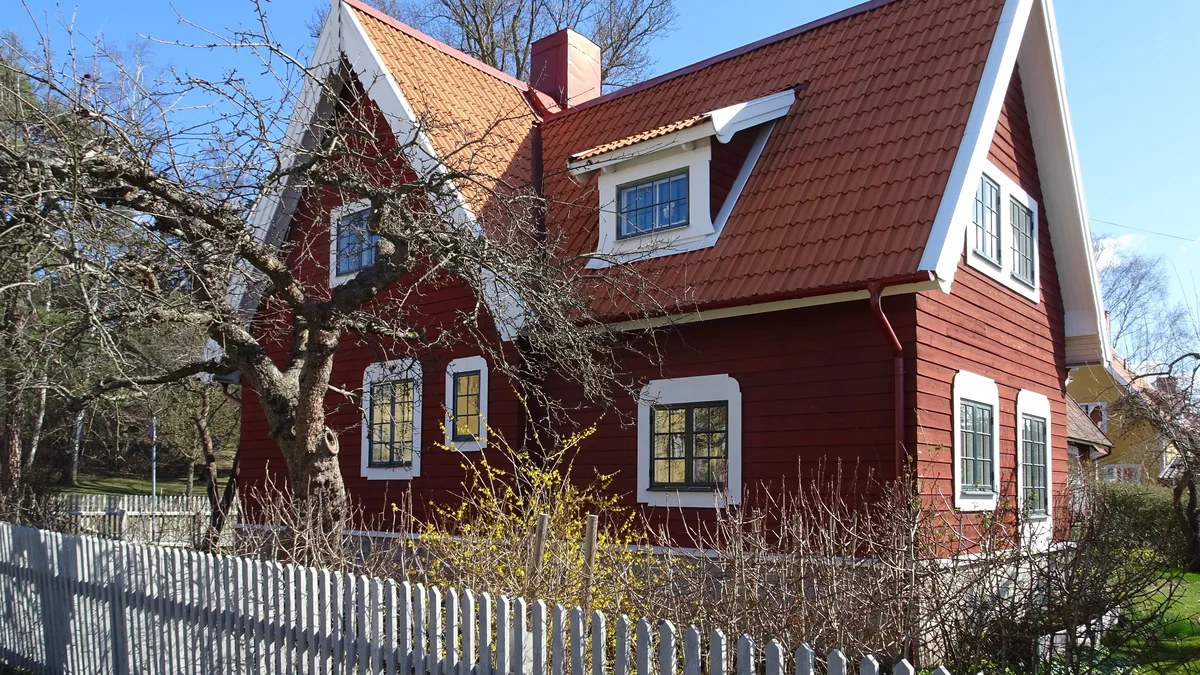
Photo: Wikimedia Commons / Classic Swedish single-family residential villa in Gamla Enskede, Stockholm (CC BY-SA)