 Sunil Rao
On the morning of September 8, 2026, Statistics Sweden (Statistiska centralbyrån, or SCB) released its comprehensive follow-up report on recent graduates entering the labor market. The findings deliver a sobering verdict: across universities, vocational colleges, and secondary schools, entering the workforce has become significantly harder over the past two years as Sweden's prolonged economic slowdown (lågkonjunktur) curtails entry-level hiring.
Following a brief post-pandemic hiring boom in 2021 and 2022, labor market establishment has fallen across almost every discipline. However, the pain is not distributed evenly. While healthcare, medical, and public sector graduates continue to transition into full-time roles with near-total certainty, the once-unstoppable technology and IT sector has suffered a dramatic reversal of fortune.
For domestic and international graduates alike, the new data carries far-reaching consequences for career planning, student debt management, and immigration status.
1. The Big Picture: Labor Market Establishment Falls Across All Degree Types
SCB tracks graduates at 3, 6, 9, 12, 24, and 36 months following the completion of their studies using monthly registry data from the Population Labor Market Status database (Befolkningens arbetsmarknadsstatus, or BAS).
Looking at the milestone six months after graduation, the proportion of students who successfully established themselves in stable employment dropped across all four tracked educational tracks:
| Education Level | Value (2022 Peak) | Notes |
|---|---|---|
| University (Högskola) | 80% in 2024 | Down from 86% in 2022. A 6 percentage point decline over two years. |
| Vocational College (Yrkeshögskola) | 73% in 2024 | Plunged 10 percentage points from 83% in 2022. Hardest hit tertiary track. |
| Adult College (Folkhögskola) | 53% in 2024 | Down from 60% in 2022 for post-secondary vocational diplomas. |
| Upper Secondary Vocational | 48% in 2024 | Fell from 59% in 2022. Less than half now find stable work within six months. |
The steepest drop occurred within Higher Vocational Education (Yrkeshögskola, or YH). Traditionally praised for its tight integration with corporate employers through mandatory workplace internships (Lärande i arbete, or LIA), YH programs saw six-month employment rates drop by 10 full percentage points between 2022 and 2024. When companies freeze junior hiring, internship-to-hire pipelines are the first to close.
2. Sector Divergence: The Tech Collapse vs. The Healthcare Fortress
The most striking revelation in SCB's 2026 report is the stark divergence between academic fields when measured 12 months after graduation:
| Field of Study & Institution | Value (12-Mo Rate) | Notes |
|---|---|---|
| Data & IT (Yrkeshögskola) | 67% in 2024 | Down from 83% in 2021 and 2022. A massive 16 percentage point collapse. |
| STEM & Computing (Högskola) | 69% in 2024 | Dropped from 80% in 2022. General science and math degrees hit by tech freeze. |
| Healthcare & Nursing (Högskola) | 89% in 2024 | Held steady at 90% in 2022/2023. Immune to broader macroeconomic downturn. |
| Healthcare & Social Care (YH) | 86% in 2024 | Virtually unchanged from 87% in 2022. High demand in elderly and specialized care. |
Why Tech Hiring Froze
During the pandemic, Swedish tech scale-ups and IT consultancies overhired junior developers and product managers under zero-interest rate assumptions. As borrowing costs rose through 2023 and 2024, venture capital funding contracted, client consulting budgets were slashed, and tech enterprises shifted focus from expansion to operational margin defense.
Senior software architects and cloud infrastructure engineers remain in high demand across Sweden, but junior developers with zero commercial experience face unprecedented competition. For vocational IT graduates, one out of every three is now unable to secure an established job one year after graduation.
Why Healthcare Remained Resilient
In sharp contrast, healthcare degrees have operated completely detached from the macroeconomic business cycle. Sweden's 21 healthcare regions face structural demographic pressures: an aging population and chronic staffing shortages among certified nurses (sjuksköterskor), biomedical analysts, and physicians.
At 89 to 90 percent establishment, healthcare graduates are practically guaranteed employment the day their degree is conferred.
3. How SCB Defines Being "Established" on the Labor Market
To understand the figures, it is essential to review SCB's statistical methodology. SCB does not simply measure whether a graduate is listed on a company payroll; it measures whether they have achieved genuine financial self-sufficiency.
Under the register-based standard:
- An individual is defined as established (förankrad på arbetsmarknaden) if their annual employment income reaches at least three Income Basic Amounts (Inkomstbasbelopp, or IBB).
- In 2026, one IBB is statutory set at SEK 80,600.
- Three IBB equals an annual gross income of SEK 241,800, which translates to earning approximately SEK 20,150 per month.
If a graduate works an occasional hourly shift in retail or freelances for SEK 8,000 a month while searching for an engineering position, SCB classifies them as not established on the labor market.
4. The International Student Double-Squeeze: SCB vs. Work Permit Laws
While the report highlights difficulties for domestic Swedish students, the situation is drastically more dangerous for non-EU international graduates who completed bachelor's or master's degrees at institutions like KTH, Chalmers, Lund, or Uppsala University.
The 12-Month Job Seeker Countdown
Under Chapter 5b, Section 1 of the Swedish Aliens Act (Utlänningslagen), non-EU graduates can apply for a residence permit to seek employment or explore business opportunities (uppehållstillstånd för att söka arbete efter avslutade studier). This permit grants a strict, non-extendable window of 12 months.
The Salary Floor Conflict (SEK 20k vs. SEK 34,470)
Here lies the regulatory trap:
- SCB considers a graduate established if they earn SEK 20,150 per month.
- However, the Swedish Migration Agency (Migrationsverket) enforces a statutory work permit salary floor benchmarked at 90 percent of the national median wage: exactly SEK 34,470 per month for 2026.
In a tight labor market where companies offer entry-level traineeships, fixed-term probationary contracts, or junior positions paying SEK 28,000 to SEK 32,000 per month, domestic graduates can accept the job and build experience. International graduates cannot.
If an international graduate cannot negotiate a contract paying at least SEK 34,470 per month with standard collective agreement benefits before their 12-month job seeker visa expires, their work permit application will be rejected, forcing them to leave Sweden regardless of their academic achievements.
5. Worked Case Studies: Tech Graduate vs. Healthcare Graduate
The case studies below illustrate the divergent paths facing recent university graduates in Sweden's 2026 economic environment:
Case Study A: Junior Software Engineer Graduate (Tech Squeeze)
Profile: Vikram, 25, completed an MSc in Computer Science at KTH in June 2025. He holds a 12-month post-study job seeker visa expiring in June 2026.
- Job Hunt Duration: 8 months, 120 applications, 4 technical interviews.
- Offer Received: Junior Frontend Developer at a Stockholm digital marketing agency.
- Offered Salary: SEK 31,500 per month.
- SCB Establishment Metric: Pass (SEK 31.5k/mo exceeds the 3 IBB ~SEK 20k threshold).
- Migrationsverket Work Permit Test: FAILED. The offer is SEK 2,970 below the mandatory SEK 34,470 monthly salary threshold.
- Outcome: Because the employer refuses to increase the entry-level salary budget to meet the 90% median wage floor, Vikram cannot convert his permit and must either secure a tech startup exemption (75% floor = SEK 28,725) or relocate abroad.
Case Study B: Certified Nurse Graduate (Healthcare Fortress)
Profile: Elena, 24, completed a Bachelor of Science in Nursing at Karolinska Institutet in January 2026.
- Job Hunt Duration: Received two job offers two months before formal graduation.
- Offer Accepted: Emergency Ward Nurse at Region Stockholm.
- Starting Base Salary: SEK 36,200 per month + shift differentials (OB-tillägg).
- SCB Establishment Metric: Pass.
- Migrationsverket Work Permit Test: PASSED. Base salary comfortably exceeds the SEK 34,470 statutory threshold.
- Outcome: Immediate two-year work permit approval, zero gap in legal residency, and clear trajectory toward permanent residency.
6. NordDaily Tips for Recent Graduates
- Apply for CSN Income-Adjusted Reductions Immediately: If you graduated with CSN debt and earn below the repayment threshold due to unemployment, do not default. Log in to CSN.se and apply for nedsättning av årsbelopp. CSN will recalculate your monthly debt service based on your verified taxable earnings, reducing or pausing payments for up to 12 months.
- Join an A-kassa Fund on Your First Working Day: You need 12 months of fund membership and a verified work requirement to qualify for income-related unemployment insurance (up to 80% of salary, capped at SEK 1,200/day). Sign up for an academic fund like Akademikernas a-kassa (AEA) or Unionen immediately upon landing your first contract or summer job.
- Target Tech Startups if Salary Offers Fall Under SEK 34,470: If you are an international graduate struggling to hit the SEK 34,470 work permit floor, look for innovative tech startups certified by Tillväxtverket. Under Sweden's startup exemption rules, certified early-stage ventures can sponsor qualified tech talent at a reduced floor of 75% of the median wage (SEK 28,725/month).
- Register with Arbetsförmedlingen on Day One: Registering as an active job seeker with the public employment service immediately upon graduation is mandatory to protect your Sickness Benefit Qualifying Income (SGI) with Försäkringskassan, preventing your social safety net floor from resetting to zero.
7. Frequently Asked Questions
How does Statistics Sweden (SCB) define an established worker?
In its register-based tracking, SCB considers an individual established on the labor market (förankrad på arbetsmarknaden) if their annual earned employment income equals or exceeds three Income Basic Amounts (Inkomstbasbelopp, or IBB). In 2026, with one IBB set at SEK 80,600, this threshold requires earning roughly SEK 241,800 per year, or approximately SEK 20,000 per month.
Which academic sectors suffered the steepest hiring declines?
The technology and IT sector experienced the sharpest downturn. For higher vocational education (Yrkeshögskola) IT graduates, the proportion established in the labor market 12 months after graduation collapsed from 83% in 2021 down to 67% in 2024. University degrees in science, mathematics, and computing also fell from 80% to 69%.
Which fields remain safe from the graduate hiring slump?
Healthcare and social care programs demonstrated extraordinary resilience. Both university nursing and medical graduates (89% established at 12 months) and vocational healthcare graduates (86% established) showed virtually zero decline compared to previous years, driven by acute public sector staffing shortages across Swedish regions.
How does the graduate slump affect non-EU international students?
Non-EU students face a severe regulatory double-squeeze. While SCB considers someone established at roughly SEK 20,000 per month, Sweden's reformed work permit law mandates a minimum gross monthly salary floor of SEK 34,470 (90% of the national median wage). International graduates holding a 12-month job seeker visa who receive junior or part-time offers below this threshold cannot convert to a work permit and must leave Sweden.
Can unemployed graduates pause their CSN student loan repayments?
Yes. If your annual income drops due to unemployment or entry-level job delays, you can submit an application to CSN for reduced annual repayment (nedsättning av årsbelopp). CSN recalculates your required payment based on verified taxable income, reducing or entirely pausing debt collection until your earnings recover.
8. Sources & Official References
Related articles
Frequently asked questions
How does Statistics Sweden (SCB) define an established worker?
In its register-based tracking, SCB considers an individual established on the labor market (förankrad på arbetsmarknaden) if their annual earned employment income equals or exceeds three Income Basic Amounts (Inkomstbasbelopp, or IBB). In 2026, with one IBB set at SEK 80,600, this threshold requires earning roughly SEK 241,800 per year, or approximately SEK 20,000 per month.
Which academic sectors suffered the steepest hiring declines?
The technology and IT sector experienced the sharpest downturn. For higher vocational education (Yrkeshögskola) IT graduates, the proportion established in the labor market 12 months after graduation collapsed from 83% in 2021 down to 67% in 2024. University degrees in science, mathematics, and computing also fell from 80% to 69%.
Which fields remain safe from the graduate hiring slump?
Healthcare and social care programs demonstrated extraordinary resilience. Both university nursing and medical graduates (89% established at 12 months) and vocational healthcare graduates (86% established) showed virtually zero decline compared to previous years, driven by acute public sector staffing shortages across Swedish regions.
How does the graduate slump affect non-EU international students?
Non-EU students face a severe regulatory double-squeeze. While SCB considers someone established at roughly SEK 20,000 per month, Sweden's reformed work permit law mandates a minimum gross monthly salary floor of SEK 34,470 (90% of the national median wage). International graduates holding a 12-month job seeker visa who receive junior or part-time offers below this threshold cannot convert to a work permit and must leave Sweden.
Can unemployed graduates pause their CSN student loan repayments?
Yes. If your annual income drops due to unemployment or entry-level job delays, you can submit an application to CSN for reduced annual repayment (nedsättning av årsbelopp). CSN recalculates your required payment based on verified taxable income, reducing or entirely pausing debt collection until your earnings recover.
Estimate only. Talk to a qualified adviser before acting on anything here.
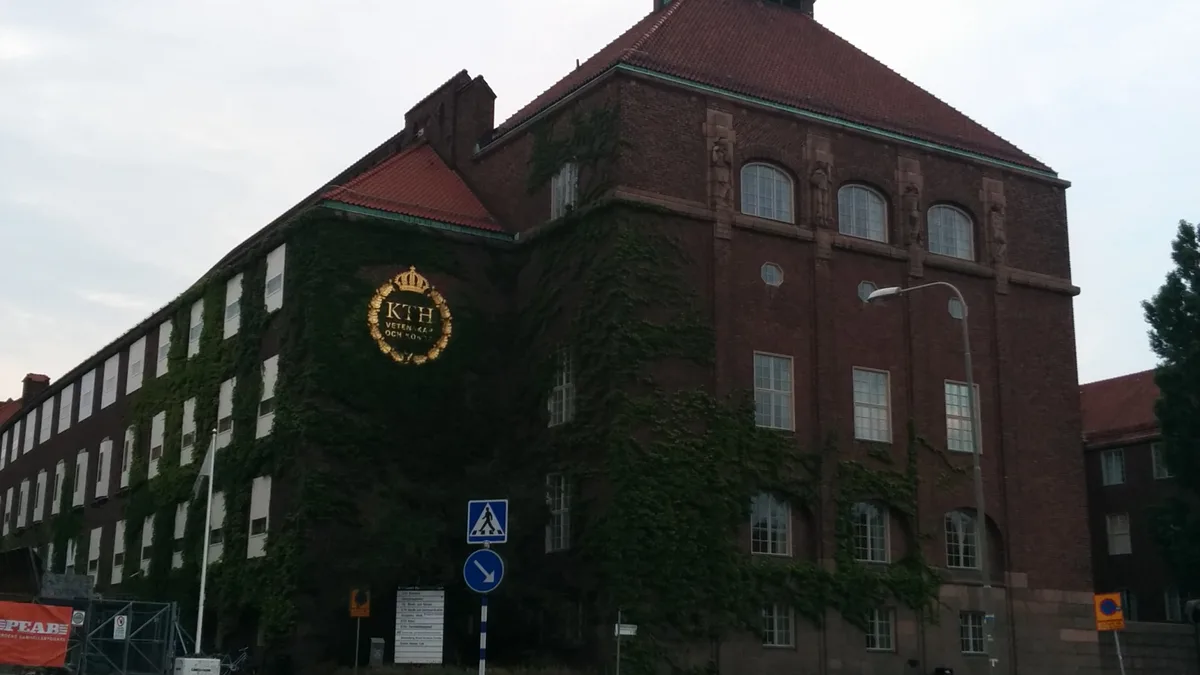
Photo: Wikimedia Commons / KTH Royal Institute of Technology main campus courtyard, Stockholm (CC BY-SA)