 Sunil Rao
For international professionals, researchers, and families living in Sweden, transitioning away from temporary, employer-tied work permits is a major life milestone. Once you accumulate continuous legal residency, you face a pivotal strategic choice: should you maintain a Permanent Residence Permit (permanent uppehållstillstånd, or PUT), or should you take the final step and apply for Swedish citizenship (svenskt medborgarskap)?
At first glance, both legal statuses seem to achieve the same primary goal: they free you from employer-sponsored visa sponsorship, eliminate the fear of a two-year renewal rejection, and give you an open-ended right to build your life in Sweden. However, beneath the surface, permanent residency and citizenship carry profoundly different constitutional protections, global mobility rights, civic privileges, and long-term risks.
This comprehensive guide analyzes every legal difference between a Swedish Permanent Residence Permit and Swedish citizenship, explores the major travel and relocation traps, and provides a clear decision framework for expats from all nationalities.
1. The Fundamental Legal Distinction: Resident Alien vs. Sovereign Citizen
The core difference between the two statuses lies in your constitutional relationship with the Swedish state:
- Permanent Residence Permit (PUT): You remain an alien (utländsk medborgare) under the Swedish Aliens Act (Utlänningslagen). The state grants you permission to reside, work, and access the Swedish social security system indefinitely, but that permission remains conditional on your ongoing ties to Sweden and adherence to immigration laws.
- Swedish Citizenship (Medborgarskap): You become a sovereign member of the Swedish polity under the Swedish Citizenship Act (Lag om svenskt medborgarskap). You possess an absolute constitutional right to enter, live in, and remain in Sweden that cannot be overridden by administrative decisions of the Swedish Migration Agency (Migrationsverket).
2. Constitutional Security vs. Revocation Risks: The Moving Abroad Trap
By far the most dangerous misconception among international residents is assuming that a Permanent Residence Permit is truly permanent regardless of where you live. Under Swedish immigration law, it is not.
The 1-Year and 2-Year Revocation Rules for Permanent Residents
Under Chapter 7, Section 7 of the Swedish Aliens Act, Migrationsverket has statutory authority to revoke your permanent residency if you settle abroad or reside outside Sweden for an extended period:
- The Automatic 1-Year Trigger: If you move out of Sweden and take up residence in another country for more than one year without notifying Migrationsverket in advance, your PUT can be formally revoked. The moment you deregister from the Swedish population register (Skatteverket folkbokföring) to relocate abroad for a job or study, Migrationsverket is notified via automated agency data sharing.
- The 2-Year Notification Extension: You can protect your PUT for up to two years if you submit an official notification (anmälan om att behålla permanent uppehållstillstånd) to Migrationsverket before leaving Sweden. However, if you do not return and re-establish habitual residency before the 24-month deadline expires, your permanent residency lapses automatically.
Constitutional Immunity for Swedish Citizens
By contrast, Swedish citizenship is permanent and lifelong. Under Chapter 2, Section 7 of the Swedish Instrument of Government (Regeringsformen), one of Sweden's four foundational constitutional acts, no Swedish citizen who resides in Sweden or who has acquired Swedish citizenship may be deprived of their nationality.
As a Swedish citizen:
- You can move to another continent for 5, 10, or 30 years without any impact on your citizenship.
- You retain an unconditional constitutional right to return to Sweden at any moment without asking for permission, undergoing health checks, or proving financial maintenance.
- Your children born abroad inherit Swedish citizenship by birth right under Chapter 1 of the Citizenship Act.
3. Travel Freedom, Passports, and European Union Mobility
The difference in global freedom of movement between holding a Swedish residence card and holding a Swedish passport is vast.
1. Passport Power and Visa-Free Global Travel
When you hold a Swedish Permanent Residence Permit, your international travel document remains the passport issued by your country of citizenship. A Swedish PUT card is not a passport; it is simply an entry document proving you are authorized to live in Sweden.
If your birth passport has weak visa mobility (for example, passports that require advance visas for travel to the United States, United Kingdom, Canada, or Japan), holding a Swedish permanent residency does not eliminate those visa requirements. You must still apply for visitor visas at foreign embassies, pay application fees, and submit biometric data.
A Swedish passport, on the other hand, consistently ranks among the top three most powerful passports globally, granting visa-free or visa-on-arrival access to over 190 countries worldwide, including the US (via ESTA), the UK, Canada, Australia, and New Zealand.
2. The EU Freedom of Movement Reality
Many expatriates mistakenly believe that having permanent residency in an EU member state gives them the right to live and work anywhere in Europe. This is completely false:
- With a Swedish PUT: You have the right to travel as a tourist in the Schengen Area for up to 90 days within any 180-day window. However, you have zero legal right to take up employment in Germany, establish a business in the Netherlands, or retire in Spain. Doing so requires applying for a national visa and work permit under that specific country's immigration quotas.
- With Swedish Citizenship: You automatically become a Citizen of the European Union under Article 20 of the Treaty on the Functioning of the European Union (TFEU). You possess the unrestricted fundamental right to live, work, study, start a company, and retire across all 27 EU member states, plus Iceland, Liechtenstein, Norway, and Switzerland, with no visa applications or employer sponsorships required.
4. Voting Rights & Democratic Participation
Your legal status directly determines your voice in Swedish democracy:
- Municipal and Regional Elections (Kommun- och regionval): Permanent residents who have been registered in the Swedish population register for three consecutive years prior to election day possess the full right to vote and stand for election in their local municipality (kommunfullmäktige) and regional council (regionfullmäktige). This allows permanent residents to influence local school funding, public transit, and regional healthcare administration.
- National Parliamentary Elections (Riksdagsval): Only Swedish citizens possess the constitutional right to vote for the 349 members of the Swedish Parliament (Sveriges Riksdag) or run for parliamentary office. As a permanent resident, you cannot vote on national legislation, income tax reforms, foreign policy, or immigration laws.
- European Parliament Elections: Only Swedish citizens (and EU citizens registered in Sweden) can vote for members of the European Parliament. Non-EU permanent residents are entirely excluded from EU elections.
5. Employment Restrictions and Security-Cleared Careers
In the private commercial sector, permanent residents and citizens enjoy identical treatment under the Swedish Discrimination Act (Diskrimineringslagen). An employer in tech, finance, engineering, or retail cannot reject an applicant simply because they hold permanent residency rather than Swedish citizenship.
However, in the public sector and national security spheres, Swedish law establishes strict citizenship requirements under the Public Employment Act (Lag om offentlig anställning) and the Security Protection Act (Säkerhetsskyddslagen):
- Police and Law Enforcement: Police officers (poliser) and customs officers (tulltjänstemän) must be Swedish citizens.
- Judiciary and Prosecution: Judges (domare) and public prosecutors (åklagare) must hold Swedish citizenship.
- Armed Forces: Military personnel in the Swedish Armed Forces (Försvarsmakten) must be Swedish citizens.
- Security Class 1 and 2 Positions (Säkerhetsklassade tjänster): High-level civil service roles within the Government Offices (Regeringskansliet), Swedish Security Service (Säkerhetspolisen or SÄPO), Defense Materiel Administration (FMV), and civilian nuclear infrastructure require Swedish citizenship and extensive security vetting.
6. Comprehensive Rights Comparison Table
The table below provides a side-by-side comparison of rights, obligations, and security between a Swedish Permanent Residence Permit and full Swedish Citizenship:
| Civic / Legal Dimension | Permanent Residence Permit (PUT) | Swedish Citizenship (Medborgarskap) |
|---|---|---|
| Legal Basis | Aliens Act (Utlänningslagen SFS 2005:716) | Citizenship Act (SFS 2001:82) & Instrument of Government (Regeringsformen) |
| Right to Live in Sweden | Indefinite, but conditional on maintaining residence in Sweden. | Absolute constitutional right that cannot be revoked under any circumstances. |
| Risk of Revocation | Can be revoked if living outside Sweden for over 1 year (or 2 years with notice), or for serious criminal offenses. | Zero risk. Revocation of acquired citizenship is unconstitutional under Swedish law. |
| Passport & Identification | Foreign passport + Swedish residence permit card (uppehållstillståndskort). | Official Swedish Passport & National Identity Card (nationellt ID-kort). |
| EU Mobility Rights | Tourist travel only (up to 90 days in 180 days within Schengen). No automatic right to work in other EU states. | Full EU Citizenship: unconditional right to live, work, and retire anywhere across 27 EU nations. |
| Voting Rights | Local municipal and regional elections only (after 3 years of registered residence). | All elections: Municipal, Regional, National Parliament (Riksdag), and EU Parliament. |
| Government & Security Jobs | Restricted from police, military, judiciary, and high security clearance positions. | Full eligibility for all public sector, judicial, defense, and security-classified careers. |
| Consular Protection Abroad | Protected only by your country of nationality. Swedish embassies cannot intervene on your behalf overseas. | Full Swedish diplomatic protection and consular assistance through Swedish and EU embassies worldwide. |
| Children Born Abroad | Children do not automatically acquire Swedish status if born outside Sweden. | Children automatically inherit Swedish citizenship by descent regardless of country of birth. |
7. Dual Citizenship Rules: Country-Specific Dilemmas
Because Sweden fully embraces dual citizenship without restriction, the primary friction point for expats is not Swedish law, but the nationality laws of their country of birth.
Countries Allowing Dual Citizenship (The Easy Decision)
Citizens of the United Kingdom, United States, Canada, Australia, France, Italy, and most Western European nations can acquire Swedish citizenship while retaining their birth citizenship. In these cases, applying for Swedish citizenship is almost always advantageous because you sacrifice zero ancestral rights while gaining full EU citizenship and permanent protection in Sweden.
Countries Prohibiting Dual Citizenship (The Hard Decision)
For expats from nations that enforce single-citizenship policies, acquiring Swedish citizenship requires formally or automatically relinquishing birth nationality:
- India: The Constitution of India does not permit dual citizenship. Acquiring a Swedish passport terminates Indian citizenship automatically. However, former citizens can apply for Overseas Citizen of India (OCI) status, which grants lifelong visa-free entry, residence, and economic parity in India (excluding agricultural land acquisition and voting).
- Singapore, China, and Malaysia: These nations enforce strict prohibitions on dual citizenship. Taking Swedish citizenship results in complete loss of original passports, national voting rights, and state housing/pension programs in those countries.
- Japan: Article 14 of the Japanese Nationality Act requires citizens acquiring another nationality by choice to select one nationality and renounce the other.
8. Worked Decision Framework: Real-World Expat Case Studies
To understand how these legal considerations intersect in everyday life, review two real-world case studies:
Case Study A: Software Architect from India (Dual Nationality Prohibited)
Profile: Rajesh, 34, a senior software architect living in Stockholm with his spouse and daughter for 5 years on continuous work permits. His parents own family property in Bengaluru.
The Dilemma: Applying for Swedish citizenship means automatically forfeiting Indian citizenship. Should he stop at permanent residency or acquire citizenship?
Analysis:
- If Rajesh keeps PUT: He can live and work in Sweden indefinitely. He retains his Indian passport and inheritance rights. However, if his company offers him a 3-year transfer to London or Zurich, his Swedish PUT will be permanently revoked after 1 to 2 years abroad. Furthermore, every family trip to Spain or Germany remains tied to his Indian passport.
- If Rajesh takes Swedish Citizenship: He loses Indian citizenship but qualifies for an OCI card, which protects his right to visit India visa-free and manage family financial assets. In return, he and his daughter acquire European Union citizenship, unlocking permanent security in Sweden and visa-free access across the continent.
- Verdict: Rajesh opts for Swedish citizenship because his family has established long-term roots in Europe and the OCI card sufficiently preserves his Indian property and travel ties.
Case Study B: Management Consultant from the UK (Dual Nationality Permitted)
Profile: Sarah, 41, a management consultant from Manchester living in Gothenburg since 2019.
The Dilemma: Following Brexit, Sarah holds post-Brexit permanent residency status in Sweden under the EU-UK Withdrawal Agreement. She wants to know whether acquiring a Swedish passport is necessary.
Analysis:
- Both Sweden and the United Kingdom allow dual citizenship without restriction. Sarah will not lose her British passport, her National Insurance record, or her property rights in the UK.
- Her current Swedish residence card only allows her to live in Sweden. It does not restore the EU freedom of movement rights that British citizens lost after Brexit.
- By acquiring Swedish citizenship, Sarah restores her full European Union citizenship, enabling her to consult freely for clients across Germany, France, and Scandinavia without corporate visa restrictions.
- Verdict: Applying for Swedish citizenship is an unambiguous win with zero downsides.
9. NordDaily Tips for Choosing Your Status
- Do Not Travel on an Expired National Passport: Your Swedish permanent residency card is valid only when paired with a valid national passport. If your home country passport expires, renew it immediately. You cannot board international flights with just a PUT card.
- File the 2-Year Absence Notice Before Relocating Abroad: If you must temporarily leave Sweden for work or family care while holding PUT, always submit Form 187011 (Anmälan om att behålla permanent uppehållstillstånd) to Migrationsverket before leaving the country to protect your status for up to 24 months.
- Track Your Travel Days for the Habitual Residence Test (Hemvist): When applying for citizenship, Migrationsverket deducts any vacation or business trip outside Sweden that exceeded six continuous weeks from your cumulative residence time. Maintain an exact log of international entry and exit dates.
- Verify Family Reunification Maintenance Requirements: Sponsoring family members under permanent residency requires satisfying strict housing and income maintenance rules (försörjningskrav). While Swedish citizens sponsoring spouses also face maintenance rules, the exemptions are broader if you have established long-term domicile in Sweden.
- Consider Your Long-Term Retirement Plans: If you plan to spend your retirement years splitting time between Sweden and Southern Europe (such as Spain or Portugal), Swedish citizenship is essential. Spending more than two continuous years outside Sweden will strip you of permanent residency, but has zero impact on a Swedish citizen.
10. Frequently Asked Questions
Can a Swedish Permanent Residence Permit (PUT) ever be revoked?
Yes. Unlike citizenship, a Permanent Residence Permit is not absolute. Migrationsverket can revoke your permanent residency if you move your habitual residence outside Sweden for more than one year (or more than two years if you submit a prior notification to preserve your status). It can also be revoked if you obtained the permit through fraudulent representations or commit serious criminal offenses resulting in a court deportation order.
Can Swedish citizenship ever be revoked once granted?
No. Under Chapter 2, Section 7 of the Swedish Instrument of Government (Regeringsformen), which is part of Sweden's Constitution, no citizen who is resident in Sweden or who has acquired Swedish citizenship may be deprived of their citizenship. Even if you live abroad for decades, your Swedish citizenship cannot be cancelled.
Can permanent residents vote in Swedish national elections?
No. Permanent residents who have lived in Sweden for at least three consecutive years can vote and stand as candidates only in municipal elections (kommunalval) and regional council elections (regionval). Voting in national parliamentary elections (riksdagsval) and European Parliament elections is strictly reserved for Swedish citizens.
Does a Swedish Permanent Residence Permit allow me to work in other EU countries?
No. A Swedish Permanent Residence Permit grants residency and work authorization exclusively in Sweden. For other European Union nations in the Schengen area, it functions only as a tourist visa waiver permitting visits of up to 90 days in any 180-day period. To live and work freely across the EU without separate national work visas, you need full Swedish EU citizenship.
Does Sweden allow dual citizenship?
Yes. Sweden has permitted unrestricted dual and multiple citizenship since July 1, 2001. You do not need to renounce your original nationality to become a Swedish citizen under Swedish law. However, whether you can keep your original nationality depends on the domestic laws of your country of birth (for instance, India, Singapore, China, and Japan generally prohibit dual citizenship).
11. Official Sources & Legal Framework
- The Swedish Instrument of Government (Regeringsformen SFS 1974:152 Chapter 2): Constitutional protection against deprivation of Swedish citizenship.
- The Swedish Citizenship Act (Lag 2001:82 om svenskt medborgarskap): Statutory conditions for acquisition of citizenship through naturalization (naturalisation) and dual citizenship recognition.
- The Swedish Aliens Act (Utlänningslagen SFS 2005:716 Chapter 7): Statutory conditions for granting and revoking permanent residence permits (återkallelse av permanent uppehållstillstånd).
- Swedish Migration Agency (Migrationsverket): Official procedural directives for filing absence notifications to protect permanent residency (Anmälan om att behålla PUT).
Related articles
Frequently asked questions
Can a Swedish Permanent Residence Permit (PUT) ever be revoked?
Yes. Unlike citizenship, a Permanent Residence Permit is not absolute. Migrationsverket can revoke your permanent residency if you move your habitual residence outside Sweden for more than one year (or more than two years if you submit a prior notification to preserve your status). It can also be revoked if you obtained the permit through fraudulent representations or commit serious criminal offenses resulting in a court deportation order.
Can Swedish citizenship ever be revoked once granted?
No. Under Chapter 2, Section 7 of the Swedish Instrument of Government (Regeringsformen), which is part of Sweden's Constitution, no citizen who is resident in Sweden or who has acquired Swedish citizenship may be deprived of their citizenship. Even if you live abroad for decades, your Swedish citizenship cannot be cancelled.
Can permanent residents vote in Swedish national elections?
No. Permanent residents who have lived in Sweden for at least three consecutive years can vote and stand as candidates only in municipal elections (kommunalval) and regional council elections (regionval). Voting in national parliamentary elections (riksdagsval) and European Parliament elections is strictly reserved for Swedish citizens.
Does a Swedish Permanent Residence Permit allow me to work in other EU countries?
No. A Swedish Permanent Residence Permit grants residency and work authorization exclusively in Sweden. For other European Union nations in the Schengen area, it functions only as a tourist visa waiver permitting visits of up to 90 days in any 180-day period. To live and work freely across the EU without separate national work visas, you need full Swedish EU citizenship.
Does Sweden allow dual citizenship?
Yes. Sweden has permitted unrestricted dual and multiple citizenship since July 1, 2001. You do not need to renounce your original nationality to become a Swedish citizen under Swedish law. However, whether you can keep your original nationality depends on the domestic laws of your country of birth (for instance, India, Singapore, China, and Japan generally prohibit dual citizenship).
Estimate only. Talk to a qualified adviser before acting on anything here.
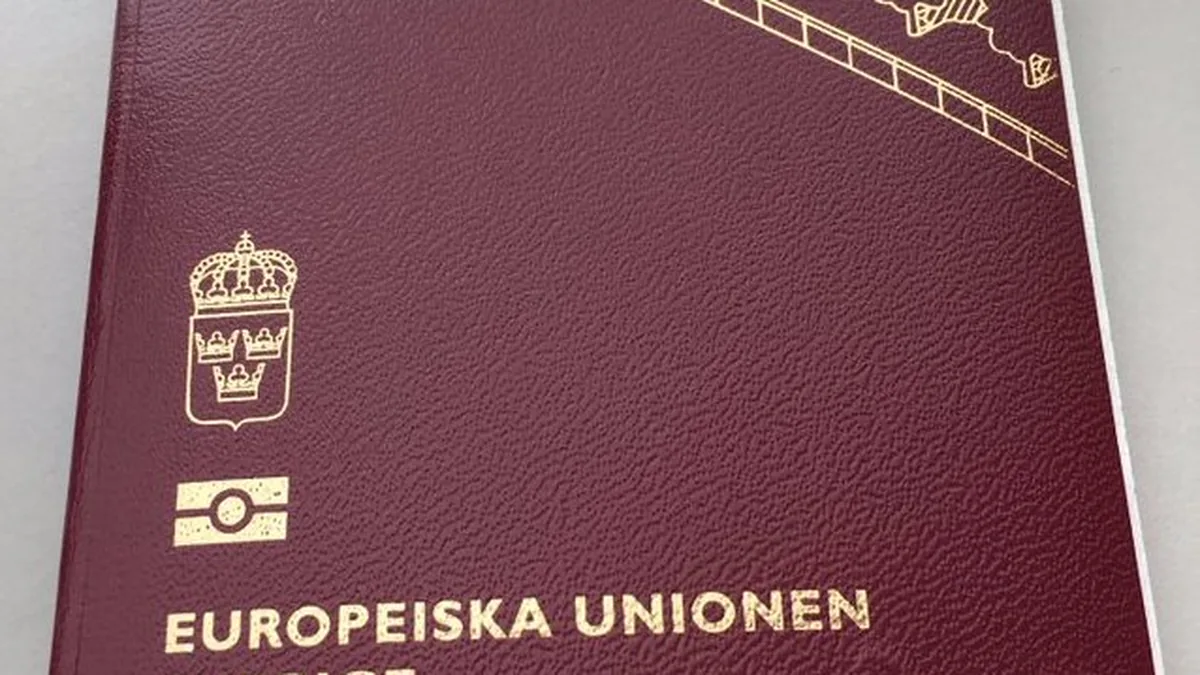
Photo: Wikimedia Commons / Swedish Passport & National ID (Public Domain)