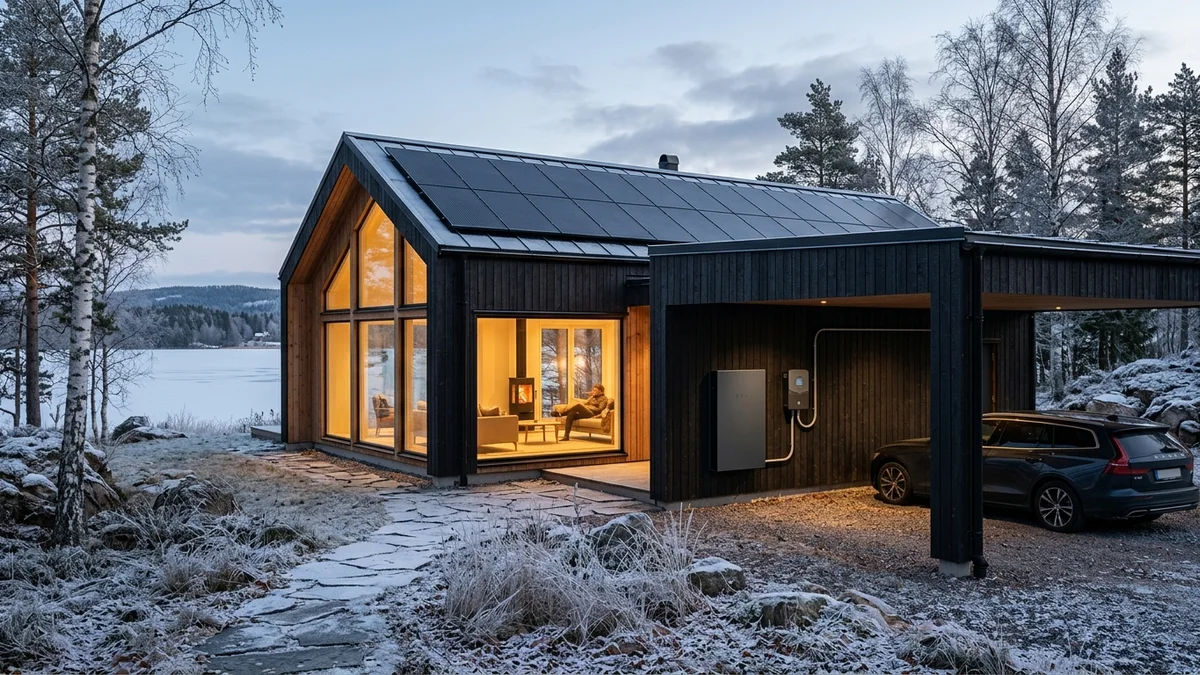
 Sunil Rao
For more than ten years, the biggest selling point for putting solar panels on a Swedish house was a generous government bonus known as the "60-öre rule." Every kilowatt-hour (kWh) of extra solar power you sent out to the public electricity grid earned you an automatic SEK 0.60 tax refund on your yearly tax return - worth up to SEK 18,000 a year. As of January 1, 2026, that 60-öre bonus is gone.
For the more than 250,000 Swedish households that already have rooftop solar panels - and for anyone thinking about buying solar panels or a home battery in 2026 or 2027 - this change flips the math upside down. Sending sunny afternoon electricity out to the grid is no longer where the real money is. Instead, your savings now depend on using as much of your own solar power at home as possible, storing midday sunshine in a home battery (with a 50% government discount), and avoiding Sweden's new peak-hour grid fees.
1. What Changed: Why Sweden Ended the 60-Ore Solar Tax Credit
When Sweden launched the 60-öre tax credit in 2015, home solar panels were expensive and rare. The government wanted to encourage homeowners (specifically those with a standard home main fuse of up to 100 amps) to install panels and share clean electricity with the grid. You could claim SEK 0.60 back in taxes for up to 30,000 kWh of power you sent to the grid each year, as long as you did not claim credit for more electricity than you bought from the grid that same year.
So why did the Swedish government end this popular bonus on January 1, 2026?
- Too Much Solar Power at Midday in Summer: Sweden now has over 4 gigawatts of solar panels installed. On bright summer afternoons - especially in southern and central Sweden (price zones SE3 and SE4) - there is often so much solar electricity on the grid that market prices drop close to zero, or even turn negative. Paying homeowners an extra SEK 0.60 per kWh to push even more power onto the grid during those hours strained local neighborhood transformers and no longer made sense.
- Encouraging Home Batteries Instead of Grid Exports: Rather than paying people to dump cheap daytime power onto the grid, Sweden now wants homeowners to store that power in home batteries or use it straight away to charge electric cars and run heat pumps.
- What This Means for Your 2026 and 2027 Tax Returns: Any extra solar power you sent to the grid during 2025 was included one last time on your spring 2026 tax return. Everything you send to the grid from January 1, 2026 onward earns SEK 0.00 in 60-öre tax credits on your 2027 and future tax returns. Your grid company will also stop sending the yearly control slip for this credit to the Swedish Tax Agency (Skatteverket).
| Solar Rule or Payment | Old Rule (Through 2025) | New Rule (2026 & 2027) | What It Means for Homeowners |
|---|---|---|---|
| 60-Öre Tax Credit for Sent Power | SEK 0.60 per kWh sent to grid (up to 30,000 kWh = max SEK 18,000/year) | SEK 0.00 per kWh (Ended January 1, 2026) | Cuts yearly cash return on exported power by roughly SEK 3,000 to SEK 7,200 for a typical house |
| Upfront Solar Panel Discount (Grön teknik) | 15% off installation bill (lowered from 20% in mid-2025) | 15% off labor and materials (up to SEK 50,000 per person/year) | Still active; two co-owners can combine up to SEK 100,000/year in total green discounts |
| Upfront Battery & EV Charger Discount (Grön teknik) | 50% off installation bill | 50% off labor and materials (up to SEK 50,000 per person/year) | Makes adding a home battery to store your own solar power the smartest investment |
| Payment From Your Electricity Company | Market spot price per kWh sent to the grid | Unchanged (paid monthly or taken off your bill) | Depends on the hourly or 15-minute market price in your zone (SE1–SE4) |
| Grid-Benefit Payment (Nätnytta) | Paid by your local grid owner (SEK 0.04 to SEK 0.12/kWh) | Still required by Swedish law | Your grid company (e.g. Vattenfall, Ellevio, E.ON) still pays you for reducing cable losses |
| Tax-Free Sales Allowance | First SEK 40,000/year per property is tax-free | First SEK 40,000/year per property is tax-free | You only pay 30% tax if total power sales plus rental income exceed SEK 40,000/year |
2. Why Using Your Own Solar Power Is Worth 4 Times More Than Selling It
Now that the 60-öre bonus is gone, there is a massive gap between what you pay to buy 1 kWh of electricity from the grid and what you earn when you sell 1 kWh back to the grid. Understanding this gap is the key to saving money in 2026 and 2027.
- What You Save When You Use 1 kWh of Your Own Solar Power: Every kWh from your roof that directly runs your heat pump, washing machine, water heater, or electric car charger is 1 kWh you do not have to buy. Buying power from the grid costs you the market electricity price (for example, SEK 0.55/kWh), plus the grid delivery fee (elöverföringsavgift, typically SEK 0.25 to SEK 0.40/kWh), plus Sweden's energy tax (energiskatt, around SEK 0.43 to SEK 0.54/kWh), plus 25% VAT (moms) on top of everything. Put together, using 1 kWh of your own solar power saves you roughly SEK 1.60 to SEK 2.20 per kWh.
- What You Earn When You Sell 1 kWh to the Grid in 2026–2027: When your roof makes more power at 1:00 PM than your house is using, the extra power flows out to the grid. Without the 60-öre tax credit, you only get the midday market price (which often dips to SEK 0.10–0.35/kWh on sunny afternoons) plus your grid company's small grid-benefit fee (typically SEK 0.05–0.08/kWh). That adds up to just SEK 0.15 to SEK 0.43 per kWh.
Simple Homeowner Math: A House in Stockholm (Zone SE3) Before vs. After 2026
Let's look at Sofia and Daniel, who live in a detached house in Täby outside Stockholm (Electricity Zone SE3). They have a 12 kW solar panel system on their roof that produces 11,500 kWh per year. Without a battery, their house uses 4,000 kWh of that solar power directly during the day (35% self-use) and sends the remaining 7,500 kWh out to the grid.
- Under the Old Rule (With the 60-Öre Bonus): Selling 7,500 kWh earned them about SEK 0.35/kWh from their electricity and grid companies (SEK 2,625) PLUS a SEK 4,500 tax refund (7,500 kWh × SEK 0.60) on their tax return. Total export income: SEK 7,125 a year.
- Under the New 2026–2027 Rule (Without a Battery): That SEK 4,500 tax refund disappears. Selling 7,500 kWh now brings in only about SEK 2,625 a year, while they still have to buy expensive evening electricity at roughly SEK 1.85/kWh (including taxes and fees) once the sun goes down.
- What Happens When They Add a 15 kWh Home Battery: Using the 50% Green Technology (Grön teknik) discount, Sofia and Daniel install a 15 kWh home battery. Now, instead of selling their extra midday solar power for SEK 0.35/kWh, the battery stores it for the evening. Their home solar use jumps from 35% (4,000 kWh) to 75% (8,600 kWh). By shifting 4,600 kWh from low-value daytime sales (SEK 0.35/kWh) to replacing expensive evening grid power (SEK 1.85/kWh), they save an extra SEK 6,900 per year (4,600 kWh × SEK 1.50 difference). That more than makes up for losing the 60-öre tax credit.
3. Tax Rules for Selling Solar Power and Battery Services
Even with the 60-öre credit gone, many homeowners wonder if they have to report their remaining solar power sales - or money earned from letting a battery company balance the power grid - to the Swedish Tax Agency (Skatteverket). For a private home or summer cottage, two generous tax-free limits protect you:
- The SEK 40,000 Tax-Free Allowance: Sweden gives every private home a standard tax-free allowance (called schablonavdrag) of SEK 40,000 per property, per year. This limit covers the combined total of money you earn from selling extra solar power, receiving grid-benefit fees (nätnytta), earning battery grid-balancing rewards (such as through CheckWatt), AND any rent you collect from letting out a room or guest cottage.
- Example A (Under SEK 40,000): You earn SEK 3,200 from selling solar power and SEK 6,000 from battery grid balancing in 2026. Your total is SEK 9,200, which is well under SEK 40,000. You pay SEK 0 in tax and do not need to report it on your tax return.
- Example B (Over SEK 40,000): You earn SEK 4,000 from solar power and also rent out your guest cottage for SEK 48,000 during the summer. Your combined total is SEK 52,000. You subtract the SEK 40,000 tax-free allowance, leaving SEK 12,000. You pay Sweden's flat 30% capital tax on that SEK 12,000, which equals SEK 3,600 in tax.
- No VAT (Moms) Registration Needed for Normal Homes: Private homeowners who sell extra solar power do not have to register for or charge VAT unless their yearly sales go above Sweden's small-business VAT limit of SEK 120,000 per year (recently raised from SEK 80,000). A normal house solar system will never come close to that limit.
4. How to Beat Sweden's New Peak-Power Grid Fees in 2026–2027
The end of the 60-öre solar credit is happening at the same time as another big change to Swedish electricity bills. By January 1, 2027, Sweden's energy regulator (Energimarknadsinspektionen) requires every local grid company in the country to introduce peak-power grid fees, known in Swedish as effekttariffer.
Under these new grid fees, part of your monthly delivery bill is based on your highest 1-hour electricity spikes (measured in kilowatts, kW) during busy daytime and evening hours - not just your total monthly usage. Running the oven, heat pump, and EV charger all at 6:00 PM will cost much more than spreading them out. Here is how solar and battery owners can beat those fees:
- Run Your Heat Pump and Hot Water Between 11:00 AM and 3:00 PM: Instead of letting your heat pump heat up your hot water tank at 6:00 PM when everyone is cooking dinner and showering, set a timer so it heats water in the middle of the day when your solar panels are producing free power.
- Use Smart Solar Charging for Your Electric Car: Modern home chargers sold in Sweden (such as Easee, Zaptec, Charge Amps, or Garo paired with a smart-meter reader) can automatically adjust charging speed to match your exact solar surplus. Your car soaks up power that would otherwise be sold for pennies, and you avoid creating a big power spike on your grid bill.
- Use Your Battery for "Peak Shaving" in Winter: From November to February, Swedish solar panels make less than 10% of their summer power. During winter, switch your battery to charge at night (between 2:00 AM and 4:00 AM) when electricity prices and grid demand are lowest, and discharge during the expensive morning (7:00–9:00 AM) and evening (5:00–8:00 PM) peaks. This cuts both your electricity price and your monthly peak-power grid fee.
What You Should Do Now
- Check your solar app or inverter settings: Make sure you are shifting heavy appliances (dishwasher, laundry, hot water, EV charging) to sunny midday hours instead of evening hours.
- Run the numbers on a home battery: If you already have solar panels, get a quote for a home battery with the 50% Grön teknik discount - especially if your local grid company has already rolled out peak-power fees (effekttariffer).
- Track your property's total extra income: Keep a simple note of your solar sales, battery rewards, and any rental income. As long as the combined total stays at or below SEK 40,000 a year, you owe zero income tax.
- Watch your 2026 vs. 2027 tax returns: Expect your final 60-öre refund for 2025 exports on your spring 2026 tax return, and plan your household budget knowing that refund will be SEK 0 from 2027 onward.
Sources
- Swedish Tax Agency (Skatteverket) - Micro-Production of Renewable Electricity on a Private Residence (Abolition of the 60-Öre Tax Reduction & SEK 40,000 Rule)
- Swedish Tax Agency (Skatteverket) - Green Technology Tax Deduction (15% Solar Panels & 50% Home Batteries / EV Chargers)
- Swedish Energy Markets Inspectorate (Energimarknadsinspektionen, Ei) - Mandatory Power Tariffs (Effekttariffer) by 1 January 2027
- Sveriges Riksdag - Swedish Income Tax Act (Inkomstskattelag 1999:1229, Chapter 42 § 30 & Chapter 67)
Official reference: Swedish Income Tax Act (Inkomstskattelagen 1999:1229, Chapter 42 § 30 & Chapter 67), Swedish Value Added Tax Act (Mervärdesskattelagen 2023:200), and Swedish Electricity Act (Ellagen 1997:857).
Related articles
Frequently asked questions
Has Sweden really ended the 60-öre tax credit for selling extra solar power?
Yes. Starting January 1, 2026, Sweden abolished the SEK 0.60 per kilowatt-hour (kWh) tax credit for home-made solar power sent to the public grid. Previously, this bonus was worth up to SEK 18,000 a year on up to 30,000 kWh of exported electricity. Any solar power you send to the grid in 2026 and 2027 no longer earns this 60-öre tax credit.
Can I still get the upfront Green Technology discount when buying solar panels or a battery?
Yes. Ending the 60-öre ongoing tax credit did not end the upfront Green Technology (Grön teknik) discount on your installation bill. In 2026 and 2027, homeowners still get an automatic 15% discount on solar panel installations, a 50% discount on home solar batteries, and a 50% discount on electric car home chargers. The limit is SEK 50,000 per person per year, and the installer takes it straight off your invoice.
Do I have to pay income tax when I sell extra solar power to my electricity company?
Usually no. Under Swedish tax rules, the first SEK 40,000 you earn each year from your home - combining solar power sales and any rental income from a room or guest cottage - is 100% tax-free. You only pay 30% tax on the amount above SEK 40,000.
What do I still get paid when I send extra solar power to the Swedish grid?
Even without the 60-öre government bonus, you still get paid in two ways for every kWh you send to the grid: (1) your electricity supplier pays you the going market price (based on the hourly or 15-minute Nord Pool price in your zone, SE1–SE4), and (2) your local grid company (such as Vattenfall, Ellevio, or E.ON) pays you a small grid-benefit fee - typically SEK 0.04 to SEK 0.12 per kWh - because your local power reduces strain on their cables.
Estimate only. Talk to a qualified adviser before acting on anything here.
Photo: Jann Lipka / imagebank.sweden.se