 Sunil Rao
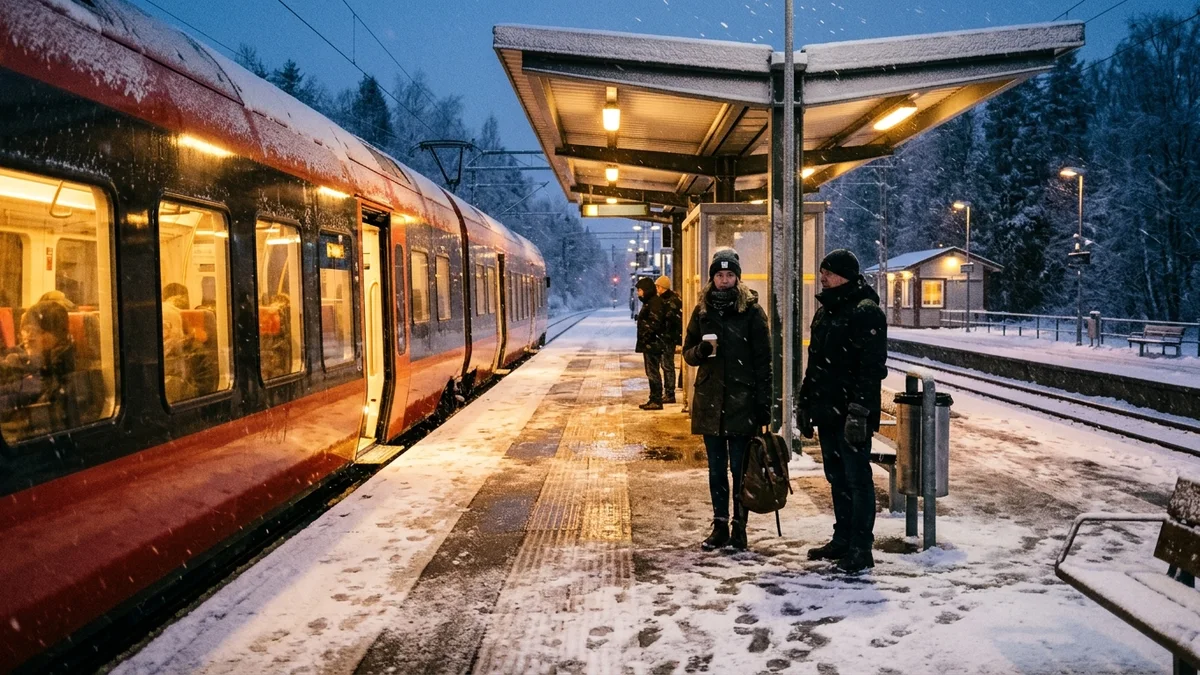
On Thursday, November 12, 2026, the Swedish Meteorological and Hydrological Institute (SMHI) issued a rare Red Weather Warning (röd vädervarning) - the highest alert level in Sweden's civil emergency system - as an intense Baltic low-pressure blizzard dumped 50 to 80 centimeters of heavy wet snow combined with gale-force winds along the Västerbotten and Norrbotten coast around Skellefteå, while Orange and Yellow snow and wind warnings swept adjacent regions. Within hours, the Swedish Transport Administration (Trafikverket) suspended regional passenger train corridors, municipal buses halted service, and authorities urged residents not to venture out onto the road network.
For international professionals living and working across Sweden, severe winter storms immediately trigger three practical legal and financial questions that are rarely explained in English onboarding handbooks: Can your Swedish employer dock your pay if a blizzard or cancelled train makes it impossible to reach the office? How do you claim a mandatory SEK 1,480 taxi refund when regional transit breaks down? And what happens to your car insurance coverage if you get stuck in a November snowstorm before the December 1 winter tire deadline?
1. Understanding SMHI's Consequence-Based Warning System (Yellow, Orange, Red)
If you moved to Sweden in recent years, you may hear longtime residents refer to "Class 1, Class 2, or Class 3 warnings." However, SMHI replaced that older meteorological scale with a modern, regionalized consequence-based warning system (konsekvensbaserade varningar) designed in collaboration with county administrative boards (länsstyrelserna) and Trafikverket.
Under the current system, the color of a warning depends not just on the raw wind speed or snowfall in millimeters, but on how severely that weather will disrupt infrastructure in that specific geographic zone (for example, 10 cm of wet snow with wind in central Gothenburg or Stockholm triggers an Orange warning much faster than 10 cm of dry snow in inland Lapland):
- Yellow Warning (Gul varning - Be Aware): Weather that may cause localized delays in public transport, slippery roads, and isolated power flickers. Commuters should allow extra travel time.
- Orange Warning (Orange varning - Be Prepared): Severe weather bringing major societal disruptions, widespread train and bus cancellations by Trafikverket, fallen trees blocking roads, and prolonged rural power outages. Employers frequently encourage remote work where duties allow.
- Red Warning (Röd varning - Act Immediately / Stay Indoors): Extreme weather with severe, life-threatening consequences for society. During a Red Snow Warning (such as the November 12, 2026 blizzard along the northeastern coast), roads become completely impassable for emergency vehicles, roofs risk structural snow-load stress, and Trafikverket and the Police actively advise the public to cancel all road journeys.
| Winter Disruption Scenario | Governing Swedish Law / Rule | Financial & Legal Outcome for Resident | Immediate Action Step |
|---|---|---|---|
| Snowstorm or train cancellation blocks your commute to work | Swedish Employment Law & Collective Agreements (Kollektivavtal) | Valid absence (giltig frånvaro, no disciplinary risk), but employer can deduct pay (löneavdrag) unless worked remotely or offset via flex/vacation | Notify your manager before shift start; request remote work, flextime, or vacation/comp offset |
| Public school or preschool (förskola) closes due to Red/Orange storm | Social Insurance Code (VAB rules) vs. Parental Leave Act | Försäkringskassan does NOT pay VAB for weather closures if the child is healthy; must remote-work, use vacation, or take parental leave days | Check if municipal emergency childcare remains open or log regular föräldrapenning / flextime |
| Regional train, metro, or bus (<150 km) is delayed 20+ minutes | Public Transport Passenger Rights Act (Lag 2015:953, §§ 14-15) | 50% to 100% ticket price refund OR taxi / own-car reimbursement up to SEK 1,480 (1/40th of 2026 Price Base Amount) | Save your taxi receipt (with VAT/reg no.) and screenshot the transit app delay notice |
| Long-distance train (≥150 km, e.g. SJ Snabbtåg / Vy) delayed 60+ minutes | EU Rail Passenger Rights Regulation (EU) 2021/782 | 25% ticket refund at 60-119 min delay; 50% refund at 120+ min delay (note: force majeure exception applies to compensation in extreme weather, but re-routing/care rights still apply) | Claim ticket refund or free rebooking directly in the SJ / operator app |
| Driving on summer tires during a snowstorm (Nov or Dec-Mar) | Road Traffic Ordinance (Trafikförordningen 1998:1276) & Insurance Care Rules | Police fine of SEK 1,200 (Dec 1-Mar 31 in vinterväglag) + insurer can slash collision payout by 20%-100% for gross negligence | Switch to approved 3PMSF friction or studded winter tires before the first November frost |
2. Swedish Employment Law: Can Your Boss Dock Your Pay in a Blizzard?
One of the biggest surprises for expats working in Sweden is discovering how strict Swedish labor law is regarding the daily commute. Under foundational precedent established by the Swedish Labour Court (Arbetsdomstolen, AD), traveling between your home and your contractual workplace is legally classified as the employee's private sphere and responsibility.
What happens legally when an SMHI Red or Orange warning, an unplowed highway, or a complete shutdown of SL, Västtrafik, Skånetrafiken, or Norrtåg prevents you from arriving on time?
- You Are Protected Against Firing or Disciplinary Warnings (Giltig frånvaro): If you make a reasonable effort to get to work (or follow official Trafikverket / Police advice not to drive during a Red Warning) and notify your employer immediately before your shift starts, your absence is classified as a valid obstacle (giltigt förfall / giltig frånvaro), never unlawful absence (olovlig frånvaro). Your employer cannot issue a formal warning or use a weather disruption as grounds for termination under the Employment Protection Act (LAS).
- However, the Principle of "No Work, No Pay" Applies by Default: Because the employer is not legally responsible for the weather or the public transit system, you are only entitled to salary for hours worked. If your job requires physical presence (for example, healthcare, retail, manufacturing, hospitality, or laboratory work) and you miss 4 hours or a full day due to snow, your employer has the legal right to make a proportional salary deduction (löneavdrag).
- Four Ways White-Collar & Unionized Workers Avoid a Salary Deduction: In practice, most salaried employees (tjänstemän) in Sweden never suffer a pay cut during a winter storm because they resolve the missed hours with their manager using one of four standard mechanisms:
- Working From Home (Distansarbete / Hemarbete): If your role can be performed on a laptop, working from home during an SMHI Orange or Red warning entitles you to 100% of your normal salary.
- Using Your Flextime Bank (Flextidssaldo): If your workplace has a flextime agreement, you simply log the delayed morning arrival against your flextime balance and make up the hours later in the month.
- Taking a Paid Vacation Day or Comp Time (Semesterdag eller kompledighet): With your manager's approval, you can convert a snowed-in day into a paid vacation day or deduct it from your accrued overtime bank.
- Checking Your Collective Agreement for Paid Leave With Special Cause (Permission): Under several major Swedish collective agreements (kollektivavtal), sudden extreme events can qualify for short paid leave (permission) at the employer's discretion.
- The VAB Trap When Schools Close Due to Snow: What if your municipality closes your child's preschool (förskola) or elementary school (grundskola) during a Red Weather Warning? Beware: you cannot claim Temporary Parental Benefit (tillfällig föräldrapenning / VAB) from Försäkringskassan strictly because a school closed due to weather or a power outage if your child is healthy! Claiming VAB when a child is not sick (or infectious) is flagged as an incorrect benefit claim under Försäkringskassan's automated compliance audits. Instead, you must either work from home while caring for your child, use regular parental benefit days (föräldrapenning), or use vacation/flextime.
3. How to Claim Up to SEK 1,480 for a Taxi Under Sweden's Travel Guarantee (Resegaranti)
If you rely on regional commuter trains, subways, trams, or buses in Sweden - such as SL in Stockholm, Västtrafik in Gothenburg, Skånetrafiken in Malmö/Lund, UL in Uppsala, Östgötatrafiken, Norrtåg, or regional SJ commuter services - you are protected by one of Europe's strongest consumer laws: the Public Transport Passenger Rights Act (Lag 2015:953 om kollektivtrafikresenärers rättigheter), which applies to all scheduled public transport lines shorter than 150 kilometers.
Unlike the EU Rail Regulation (which took away late-compensation payouts when delays are caused by "extraordinary weather circumstances"), Sweden's domestic Lag 2015:953 guarantees two powerful financial remedies as soon as there is reasonable cause to assume your trip will be delayed by more than 20 minutes at your final destination:
- Option A - Take a Taxi (or Drive Your Own Car) and Claim Up to SEK 1,480 Back (Section 14): If the departure board or transit app shows that your train or bus is cancelled or will get you to your destination more than 20 minutes late - and the transit company has not provided a replacement bus that gets you there within 20 minutes - you have the statutory right to arrange your own alternative transport (such as booking a licensed taxi, Uber, Bolt, or driving your own car) and bill the public transport authority!
- The Statutory Cap (1/40th of the Price Base Amount): Under Section 14 of Lag 2015:953, the maximum reimbursement per trip is fixed at exactly
1 / 40of the annual Price Base Amount (prisbasbelopp). For all of 2026 (where the Price Base Amount is SEK 59,200), the maximum taxi reimbursement is SEK 1,480 per journey. On January 1, 2027 (when the Price Base Amount rises to SEK 60,500), the cap automatically increases to SEK 1,512.50 per journey. - What If You Drive Your Own Car Instead? If you give up waiting at the station and drive your own car to work, the transit company reimburses you at Skatteverket's tax-free mileage rate (SEK 25 per mil / 10 km) plus any congestion tax or parking fees up to the SEK 1,480 ceiling.
- The Statutory Cap (1/40th of the Price Base Amount): Under Section 14 of Lag 2015:953, the maximum reimbursement per trip is fixed at exactly
- Option B - Wait for the Delayed Train/Bus and Claim a 50% to 100% Ticket Refund (Section 15): If you do not take a taxi and instead wait out the delay on the public transit network, you are entitled to a cash price reduction (prisavdrag) calculated on the price of the single trip (or the daily pro-rata value of your 30-day pass):
- 20 to 39 minutes delayed: 50% of the trip price refunded.
- 40 to 59 minutes delayed: 75% of the trip price refunded.
- 60 minutes or more delayed: 100% of the trip price refunded.
2026-2027 Commuter Case Study: How to File a Bulletproof SEK 1,480 Taxi Claim With SL or Västtrafik
Consider Priya, who lives in Sollentuna and commutes to central Stockholm on the SL Pendeltåg (commuter train) using a 30-day pass. On a snowy November morning, overhead wire icing causes SL to cancel three consecutive trains, meaning Priya will arrive at Stockholm City at least 35 minutes late.
- Step 1 - Screenshot the Delay Before Ordering the Taxi: Because Section 14 requires "reasonable cause to assume the journey will be delayed by more than 20 minutes" at the moment you decide to take a taxi, Priya takes a timestamped screenshot of the SL app trip planner showing the cancelled train and the 35-minute projected delay.
- Step 2 - Keep the Original Taxi Receipt (Kvitto från taxameter): Priya books a taxi to her office costing SEK 490. She makes sure she gets a complete receipt showing the taxi company's corporate ID (organisationsnummer), taxi registration plate, date, time, route, and VAT breakdown (moms).
- Step 3 - Submit Within 2 Months: Priya logs in to the SL Förseningsersättning web portal within two months, uploads her app screenshot, her 30-day SL card number, and the SEK 490 taxi receipt, and receives the full SEK 490 transferred directly to her Swedish bank account. (Note: under the law, you cannot claim both the taxi reimbursement and the 50%-100% ticket refund for the same journey - you choose whichever is higher.)
4. Winter Tire Laws (Vinterdäckslagen) & Why Driving on Summer Tires in November Risks Your Insurance
When an early-November blizzard hits Sweden before the calendar turns to December, thousands of motorists mistakenly believe they are legally allowed to drive on summer tires because the statutory winter tire window starts on December 1. In reality, Swedish traffic and insurance rules are far stricter:
- The December 1 to March 31 Statutory Mandate: Under Chapter 4, Section 18a of the Road Traffic Ordinance (Trafikförordningen 1998:1276), passenger cars (Class I) and light trucks up to 3.5 tonnes must be equipped with approved winter tires between December 1 and March 31 whenever winter road conditions (vinterväglag) prevail. Winter road conditions exist whenever there is snow, ice, slush, or frost on any part of the road surface in your area (determined by the Police on site).
- Minimum Tread Depth (3.0 mm) & The 3PMSF Symbol Rule: Summer tires require only 1.6 mm of tread depth, but winter tires on passenger cars must have at least 3.0 millimeters of tread depth (5.0 mm for heavy vehicles). Furthermore, all unstudded friction winter tires (friktionsdäck) must carry the official 3-Peak Mountain Snowflake (3PMSF / Alptopp) symbol; old-style "M+S" (Mud and Snow) all-season tires without the 3PMSF alpine symbol are illegal as winter tires in Sweden.
- When You Can Put Studded Tires (Dubbdäck) On: You are allowed to mount studded tires from October 1 through April 15 every year - AND even before October 1 or after April 15 if winter road conditions prevail or are forecast!
- The Insurance Carelessness Penalty (Aktsamhetskrav) in November Snowstorms: Even if a blizzard hits on November 12 (before the December 1 police fine window), every Swedish motor insurance policy (If, Trygg-Hansa, Folksam, Länsförsäkringar) contains a duty-of-care clause (aktsamhetskrav). Driving a car on summer tires during an SMHI snow warning or on icy November roads can be ruled gross negligence (grov vårdslöshet) if you slide into another vehicle or ditch, allowing the insurer to apply a special winter-tire deductible surcharge of SEK 5,000-10,000 or reduce your collision payout (vagnskadeersättning) by 20% to 50%.
Sources
- Swedish Meteorological and Hydrological Institute (SMHI) - Consequence-Based Weather Warnings (Yellow, Orange, Red)
- Sveriges Riksdag - Public Transport Passenger Rights Act (Lag 2015:953 om kollektivtrafikresenärers rättigheter, §§ 14-15)
- Swedish Consumer Agency (Konsumentverket / Hallå konsument) - Compensation for Delayed or Cancelled Public Transport & Taxi Rules
- Swedish Transport Agency (Transportstyrelsen) - Official Winter Tire Dates, 3.0 mm Tread Depth & 3PMSF Approval Rules
Related articles
Frequently asked questions
Can my Swedish employer deduct my salary if a snowstorm or cancelled train makes me late for work?
Yes, in principle. Under long-established Swedish labor law (Arbetsdomstolen precedent), getting to the workplace is the employee's responsibility. If severe weather prevents you from working and your job cannot be done remotely, your absence is considered a valid excuse (giltig frånvaro - meaning you cannot be disciplined or fired), but your employer has the legal right to make a salary deduction (löneavdrag) for the missed hours unless you agree to make up the time via flextime (flextid), remote work, or paid vacation/comp time.
How much can I claim for a taxi if my commuter train or bus is cancelled in Sweden?
Under Section 14 of Sweden's Public Transport Passenger Rights Act (Lag 2015:953 om kollektivtrafikresenärers rättigheter), if there is reasonable cause to assume your regional train, metro, tram, or bus (under 150 km) will be delayed by more than 20 minutes, you can take alternative transport (such as a taxi or your own car) and claim reimbursement from the transit operator (SL, Västtrafik, Skånetrafiken, UL, or SJ) up to 1/40th of the Price Base Amount - which equals SEK 1,480 per trip in 2026 (rising to SEK 1,512.50 in 2027).
What is the difference between an SMHI Yellow, Orange, and Red weather warning?
Since SMHI reformed its warning system from Class 1-3 to consequence-based warnings, Yellow (Gul varning) means weather that may cause localized disruptions; Orange (Orange varning) means severe weather bringing major societal disruptions and traffic hazards; and Red (Röd varning - the highest and rarest level, issued on November 12, 2026 for 50-80 cm of blizzard snowfall in Västerbotten) means extreme weather posing a direct danger to life, widespread power outages, and impassable road and rail networks.
When are winter tires legally mandatory in Sweden?
Under Swedish Transport Agency regulations, winter tires (studded dubbdäck or approved 3PMSF friction tires with at least 3.0 mm tread depth for passenger cars) are legally mandatory from December 1 through March 31 whenever winter road conditions (vinterväglag - snow, ice, slush, or frost on any part of the road) prevail. However, studded tires are legally permitted starting October 1 (and even earlier if winter road conditions occur), and driving on summer tires during a November snowstorm can trigger severe insurance deductible penalties if you cause an accident.
Estimate only. Talk to a qualified adviser before acting on anything here.
Photo: Per Lundström / imagebank.sweden.se