 Sunil Rao
After nearly eight weeks of post-election deadlock, Sweden's government-formation negotiations broke wide open heading into the weekend of 6 to 9 November 2026. On Friday afternoon, 6 November 2026, Speaker of the Riksdag (Talmannen) Andreas Norlén formally extended Moderate Party (Moderaterna, M) leader Ulf Kristersson's exploratory mandate (sonderingsuppdrag) beyond its original 10 November deadline after two dramatic party-leader announcements reshaped the parliamentary arithmetic in Stockholm.
First, at a Friday lunchtime press conference, Sweden Democrats (Sverigedemokraterna, SD) leader Jimmie Åkesson announced that his party is dropping its long-standing demand for cabinet ministry seats (ministerposter) and is prepared to go into opposition to allow Ulf Kristersson to form a center-right government without SD ministers. Minutes later, Center Party (Centerpartiet, C) leader Elisabeth Thand Ringqvist - whose own bid to form a centrist government was voted down by 324 to 25 in the Riksdag on Tuesday, 3 November 2026 - demanded that both Ulf Kristersson (M) and Social Democratic leader Magdalena Andersson (S) present binding "total packages" (totalpaket) covering policy, budget backing, and governance rules.
With caretaker Finance Minister Elisabeth Svantesson scheduled to table Sweden's 2027 Caretaker Budget (övergångsbudget) in the Riksdag this Thursday, 12 November 2026, the next three weeks will determine both who governs Sweden and what happens to your 2027 taxes, work permit rules, and household costs. Below is our full breakdown of the 3-9 November 2026 parliamentary developments, the 12 November Caretaker Budget, and the 27 November motion deadline.
1. Timeline of a Dramatic Week in the Riksdag (3-9 November 2026)
Under Chapter 6 of Sweden's Instrument of Government (Regeringsformen), a Prime Minister candidate proposed by the Speaker takes office unless an absolute majority of at least 175 of the Riksdag's 349 Members of Parliament vote "No" (a constitutional system known as negative parliamentarism). However, if the Riksdag rejects the Speaker's nominee four times, an extraordinary snap election (extraval) is triggered automatically within three months.
Here is how the negotiations evolved day by day between Tuesday, 3 November and Monday, 9 November 2026:
- Tuesday, 3 November 2026 (Speaker Vote #2 Fails 324-25): The Riksdag voted on Speaker Andreas Norlén's formal proposal to appoint Center Party leader Elisabeth Thand Ringqvist as Prime Minister at the head of a proposed five-party centrist coalition (C, S, KD, MP, and L). Because the Social Democrats, Christian Democrats, and Liberals had already rejected the constellation's premises, only the Center Party's own 25 MPs voted "Yes," while 324 MPs voted "No." That outcome consumed the second of the Speaker's four permitted Prime Minister votes (following the earlier rejection of Magdalena Andersson in Vote #1), leaving exactly two formal chamber votes before an automatic snap election.
- Tuesday Afternoon, 3 November 2026 (Kristersson Receives Exploratory Mandate): Immediately after the 3 November vote, Speaker Andreas Norlén summoned Moderate Party leader and caretaker Prime Minister Ulf Kristersson and granted him an exploratory mandate (sonderingsuppdrag) to investigate the conditions for forming a government tolerated by the Riksdag, with an initial reporting deadline set for Tuesday, 10 November 2026.
- Friday Lunchtime, 6 November 2026 (SD Drops Cabinet Seat Ultimatum): Throughout October, government talks on the right had been frozen because the Sweden Democrats demanded formal cabinet ministry portfolios while the Liberal Party (Liberalerna, L) and the Center Party refused to vote for or tolerate a government containing SD ministers. On 6 November 2026, SD leader Jimmie Åkesson broke that logjam at a press conference, announcing that SD is withdrawing its demand for cabinet seats and is ready to sit in opposition while tolerating Ulf Kristersson as Prime Minister of a center-right government.
- Friday Afternoon, 6 November 2026 (Center Party Demands "Total Packages"): Responding to SD's pivot, Center Party leader Elisabeth Thand Ringqvist held a press conference demanding that both Prime Minister contenders - Ulf Kristersson (M) and Magdalena Andersson (S) - present complete policy and parliamentary-support "total packages" (totalpaket). Crucially, the Center Party stipulated that if it is to release or tolerate a four-party bourgeois government (M, KD, L, and C), Kristersson must guarantee that SD will not be allowed to dictate the government's policy agenda through a Tidö-style binding contract.
- Friday Late Afternoon, 6 November 2026 (Speaker Extends Kristersson's Mandate): After speaking with Ulf Kristersson, Speaker Andreas Norlén announced on 6 November 2026 that he is extending Kristersson's exploratory mandate by several days past the original 10 November deadline so the parties can evaluate the new negotiation landscape. Norlén also emphasized that an active exploratory mandate for Kristersson does not prevent other parties - including C and S - from conducting parallel policy discussions.
| Date (November 2026) | Constitutional / Parliamentary Milestone | Key Actors & Official Numbers | Impact on Government Formation & 2027 Budget |
|---|---|---|---|
| 3 November 2026 | Riksdag Prime Minister Vote #2 (Statsministeromröstning) | Elisabeth Thand Ringqvist (C) rejected: 324 No vs. 25 Yes | 2 of 4 Speaker votes used; 2 votes remain before automatic snap election |
| 3 November 2026 | Speaker Grants Exploratory Mandate (Sonderingsuppdrag) | Speaker Andreas Norlén appoints Ulf Kristersson (M) | Tasked with testing support for a center-right government |
| 6 November 2026 | SD Withdraws Cabinet Seat Requirement + C Demands Total Packages | Jimmie Åkesson (SD) & Elisabeth Thand Ringqvist (C) | Opens potential path for a bourgeois government if C/SD red lines are bridged |
| 6 November 2026 | Speaker Extends Exploratory Mandate Beyond 10 November | Andreas Norlén & Ulf Kristersson | Gives M, KD, L, C, S, and SD extra days for policy package negotiations |
| 12 November 2026 | 2027 Caretaker Budget Bill Tabled (Övergångsbudget) | Caretaker Finance Minister Elisabeth Svantesson (M) | Statutory post-election deadline; rolls over 2026 baselines + 2027 indexation |
| 27 November 2026 | 15-Day Parliamentary Budget Motion Deadline (Motionstid) | All 8 Riksdag parties / Finance Committee (Finansutskottet) | Final deadline for parties to file counter-motions reshaping the 2027 budget |
2. Why Both Blocs Need the Center Party (or SD) to Avoid a 175-Seat Veto
Why did Jimmie Åkesson's Friday concession and Elisabeth Thand Ringqvist's counter-demands immediately prompt Speaker Andreas Norlén to extend the negotiation clock? Because under Sweden's negative parliamentarism rules, any Prime Minister nominee only survives a Riksdag vote if fewer than 175 MPs press the red "No" button.
Right now, two competing parliamentary equations are being tested behind closed doors in the Riksdag:
- Option A - A Four-Party Bourgeois Government (M + KD + L + C) or Minority (M + KD + L): Now that SD has dropped its demand for cabinet seats, Ulf Kristersson is exploring whether a traditional center-right cabinet can pass the chamber. However, a pure bourgeois government faces a delicate balancing act: if Kristersson signs a formal budget deal with SD to prevent SD from voting "No," the Center Party (and parts of the Liberals) may vote "No." Conversely, if Kristersson accepts the Center Party's demand to exclude SD from policy influence, SD has warned it will not act as a passive "doormat" (dörrmatta) and could press the red button if its core migration, criminal justice, and energy priorities are dismantled.
- Option B - A Magdalena Andersson (S) Cross-Bloc Arrangement With C, MP, and V: Because Speaker Andreas Norlén explicitly noted on 6 November 2026 that other parties are free to negotiate during Kristersson's mandate, the Center Party is simultaneously requiring Social Democratic leader Magdalena Andersson to present her own "total package" (totalpaket). For Andersson to pass a future Speaker vote, she must reconcile the Center Party's demands for lower payroll taxes, flexible labor rules, and forest property rights with the Left Party's (Vänsterpartiet, V) refusal to accept market rents or tax cuts for high earners without left-wing welfare concessions.
3. What Happens This Thursday, 12 November 2026: Inside Sweden's 2027 Caretaker Budget
Because the extended coalition negotiations mean no new government will be sworn in before Thursday, 12 November 2026, Sweden will trigger a rare constitutional mechanism this week. Under the Riksdag Act (Riksdagsordningen) and the Budget Act (Budgetlagen), a general election year allows the autumn budget bill to be delayed until mid-November, but never past 12 November.
On Thursday morning, 12 November 2026, caretaker Finance Minister Elisabeth Svantesson (M) will formally deliver the 2027 Budget Bill to the Riksdag in the form of a politically neutral Caretaker Budget (övergångsbudget). Based on the Ministry of Finance's official framework, here is exactly what is inside - and what is left out of - the 12 November 2026 bill:
- No New Unlegislated Tax Cuts or Campaign Promises: Because a caretaker government (övergångsregering) lacks a new parliamentary mandate under Chapter 6, Section 11 of Regeringsformen, the 12 November bill cannot include new discretionary income tax cuts (such as a new round of jobbskatteavdrag), new corporate subsidies, or unlegislated migration and welfare restructurings promised during the 2026 election campaign.
- Full Automatic 2027 Statutory Indexation (Pris- och löneomräkning): All existing permanent tax laws, brackets, and social insurance benefits are automatically rolled forward into 2027 using Sweden's statutory inflation and wage formulas. This guarantees that the 2027 Price Base Amount (prisbasbelopp, 60,500 SEK) and 2027 Income Base Amount (inkomstbasbelopp, 80,600 SEK) take full effect on 1 January 2027.
- Exception #1 - Swedish Armed Forces Rearmament (Försvarsmakten): With broad cross-party backing across the Riksdag, the 12 November Caretaker Budget includes the scheduled multi-billion-kronor upward adjustment in defense appropriations under Sweden's multi-year total defense resolution (totalförsvarsbeslutet) and NATO force commitments.
- Exception #2 - Crown Princess Victoria's 50th Birthday in 2027: The Ministry of Finance confirmed one minor, non-partisan expenditure addition: a 4 million SEK allocation to fund the official state celebrations of Crown Princess Victoria's 50th birthday in July 2027.
4. The 15-Day Parliamentary Motion Window (12-27 November 2026): How the Budget Can Still Change
Does tabling a caretaker budget on 12 November mean Sweden is locked into a frozen status-quo budget for all of 2027? Not necessarily. Under Swedish parliamentary procedure, tabling the Caretaker Budget on Thursday, 12 November 2026 opens a critical 15-day window that runs until Friday, 27 November 2026:
- The 27 November 2026 Counter-Motion Deadline (Följdmotioner): Once Finance Minister Svantesson delivers the Caretaker Budget on 12 November, all eight Riksdag parties have until 27 November 2026 to submit individual or joint budget motions. If Ulf Kristersson (or Magdalena Andersson) reaches a political agreement on a "total package" before 27 November, the coalition partners can file a joint budget motion in the Riksdag that inserts their agreed 2027 tax changes and spending priorities directly into the Finance Committee's (Finansutskottet) December 2026 budget vote. (In autumn 2018, the last time a caretaker budget was tabled after a prolonged Swedish government formation, M and KD used this exact motion window to pass their joint 2019 budget with SD support in December 2018.)
- The Early-2027 Amending Budget (Ändringsbudget / Vårändringsbudget): Even if the Riksdag passes the baseline Caretaker Budget in December 2026 with minimal changes, a newly installed government can immediately submit an extraordinary Amending Budget (ändringsbudget) in early 2027 or use the April 2027 Spring Fiscal Policy Bill (vårändringsbudgeten) to enact expenditure reforms and mid-year tax adjustments. However, under Swedish tax law principles against retroactive taxation, changes to annual municipal and state income tax tables normally need to be enacted before 1 January 2027 to apply for the full 2027 income year.
- Why the Riksbank Is Watching 27 November Closely: In its 4 November 2026 decision raising the policy rate to 2.00 percent, Sveriges Riksbank noted that September 2026 headline CPIF inflation was 1.5 percent, while CPIF excluding temporary 2026 fiscal tax cuts stood at 3.0 percent. Whether a new parliamentary majority uses the 27 November motion window to extend temporary 2026 indirect tax cuts (or allows them to expire as scheduled on 1 January 2027) will directly shape Sweden's headline inflation rate in early 2027.
5. What Expats, Employees & Business Owners Can Count On for 1 January 2027
For international residents, families, and company owners planning their 2027 household or corporate budgets, the most important takeaway is distinguishing between what is already locked in by permanent Swedish law and what depends on the ongoing coalition negotiations:
| Financial / Legal Rule for 2027 | 2026 Official Level | 2027 Level Under Caretaker Budget | Status (Locked In vs. Coalition-Dependent) |
|---|---|---|---|
| Price Base Amount (Prisbasbelopp, PBB) | 59,200 SEK | 60,500 SEK (+2.20%) | Locked in by statute (SCB / Government decision) |
| Income Base Amount (Inkomstbasbelopp, IBB) | 76,200 SEK | 80,600 SEK (+5.77%) | Locked in by statute (Pensionsmyndigheten / Government) |
| SGI Cap for Parental & Sick Pay (10 x PBB) | 592,000 SEK/yr (49,333 SEK/mo) | 605,000 SEK/yr (50,417 SEK/mo) | Locked in automatically via 2027 PBB |
| VAB Temporary Parental Care Cap (7.5 x PBB) | 444,000 SEK/yr (37,000 SEK/mo) | 453,750 SEK/yr (37,813 SEK/mo) | Locked in automatically via 2027 PBB |
| State Income Tax Threshold (Brytpunkt) | 660,400 SEK/yr (55,033 SEK/mo) | Automatic upward CPI + 2% indexation | Automatic indexation locked in; extra cuts require new bill |
| ISK & KF Tax-Free Allowance (Grundbelopp) | 300,000 SEK per person | 300,000 SEK per person | Permanent law in force for 2027 |
| ISK Effective Tax Rate (Above 300,000 SEK) | 1.065% (2.55% SLR) | Est. 1.188% (at 2.96% SLR on 6 Nov) | Locked in automatically by Riksgälden SLR on 30 Nov 2026 |
| Aktiebolag 3:12 Simplified Dividend Allowance (4 x IBB) | 304,800 SEK (2026 IBB) | 322,400 SEK (2027 IBB) | Locked in automatically via 2027 IBB |
| Work Permit Salary Floor (80% vs. Proposed 100% Median) | 34,470 SEK/mo (80% of 43,087 SEK) | 80% rule remains until a new government passes 100% bill | Coalition-dependent (C opposes strict 100% floor without exceptions) |
2026-2027 Financial Case Study: Expat IT Consultant & Parent in Stockholm Under the 12 November Caretaker Budget
Consider Marcus, a non-EU software architect living in Stockholm who earns 58,000 SEK per month (696,000 SEK per year), is expecting his second child in February 2027, and operates a side consulting company (Aktiebolag) with his spouse:
- 1. Higher 2027 Parental Leave Payouts (Guaranteed Under the Caretaker Budget): Because Marcus earns 58,000 SEK/month, his SGI-based parental benefit (föräldrapenning) is capped at 10 Price Base Amounts. Even though Sweden is tabling a Caretaker Budget on 12 November 2026, the statutory increase in the Price Base Amount from 59,200 SEK (2026) to 60,500 SEK (2027) automatically raises his qualifying SGI ceiling from 592,000 SEK/year (49,333 SEK/month) to 605,000 SEK/year (50,417 SEK/month) on 1 January 2027. At the 77.6 percent net SGI replacement formula (80% of 97% of 605,000 SEK divided by 365), Marcus's statutory daily parental benefit from Försäkringskassan rises from 1,259 SEK/day in 2026 to 1,286 SEK/day in 2027 (38,580 SEK per 30-day month before tax, plus his employer's 10% collective agreement föräldralön top-up).
- 2. Higher 2027 State Income Tax Threshold (Guaranteed Under the Caretaker Budget): In 2026, Marcus pays the 20 percent state income tax (statlig inkomstskatt) on the 35,600 SEK of his annual salary that exceeds the 2026 brytpunkt of 660,400 SEK/year (costing him 7,120 SEK/year in state tax). Under the Caretaker Budget, the statutory upward indexation of the skiktgräns and basic deduction (grundavdrag) automatically lifts the 2027 brytpunkt on 1 January 2027, shielding an additional slice of Marcus's 58,000 SEK monthly salary from the 20 percent state tax without requiring any new discretionary tax bill from the Riksdag.
- 3. Higher 2027 Low-Tax AB Dividend Room (Guaranteed Under the Caretaker Budget): Because the Income Base Amount (inkomstbasbelopp) jumps by 5.77 percent from 76,200 SEK in 2026 to 80,600 SEK in 2027, the baseline 3:12 low-tax dividend allowance (4 x IBB under the reformed 3:12 rule) for their Aktiebolag automatically increases by 17,600 SEK - from 304,800 SEK to 322,400 SEK taxed at 20 percent - regardless of which coalition ultimately takes office.
6. Why the Center Party's Role Matters Specifically for Expats and Work Permit Holders
Beyond taxes and the state budget, the outcome of Ulf Kristersson's extended exploratory mandate has direct consequences for international professionals working in Sweden on residence permits:
- The Work Permit Salary Floor Debate (80% vs. 100% of Median Salary): Under current rules effective since June 2026, work permit applicants must earn at least 80 percent of SCB's median wage (currently 34,470 SEK/month based on the 43,087 SEK median salary). While the previous Tidö partners (M, KD, L, and SD) proposed raising that threshold to 100 percent of the median salary (43,087 SEK/month) with narrow shortage-occupation exemptions, both the Center Party (C) and business federations (such as Svenskt Näringsliv) have strongly opposed a blanket 100 percent median floor. If the Center Party becomes part of or negotiates a "total package" with a bourgeois government, business-friendly labor migration rules and broader talent exemptions are likely to be a central bargaining chip.
- Citizenship & Permanent Residency Timelines: While both the M-led bloc and the Social Democrats support stricter language and civics testing (medborgarskapsprov) and longer residency requirements for citizenship, any pause or delay in installing a new cabinet pushes the legislative timetable for pending migration bills further into the 2026/27 Riksdag session.
Sources
- Sveriges Riksdag - Official Speaker Updates on the 2026 Government Formation: Rejection of Elisabeth Thand Ringqvist (3 Nov 2026) and Extension of Ulf Kristersson's Exploratory Mandate (6 Nov 2026)
- Government Offices of Sweden (Regeringskansliet / Finansdepartementet) - Ministry of Finance: Principles and 12 November 2026 Submission Date for the 2027 Caretaker Budget (Övergångsbudget för 2027)
- Sveriges Riksdag - The Instrument of Government (Regeringsformen 1974:152, Chapter 6 on Government Formation, Negative Parliamentarism, and Caretaker Ministries)
- Swedish Election Authority (Valmyndigheten) - Official 2026 General Election Results & Constitutional Rules for Extraordinary Elections (Extraval)
Related articles
Frequently asked questions
Why did Speaker Andreas Norlén extend Ulf Kristersson's government-formation mandate on 6 November 2026?
On Tuesday, 3 November 2026, Speaker Andreas Norlén handed Moderate Party (Moderaterna) leader Ulf Kristersson an exploratory mandate (sonderingsuppdrag) originally due to report back on 10 November 2026. However, on Friday, 6 November 2026, two major political shifts occurred: the Sweden Democrats (SD) announced they are dropping their demand for cabinet ministry posts and can tolerate a center-right government from opposition, while the Center Party (C) demanded comprehensive policy and parliamentary-support 'total packages' (totalpaket) from both Ulf Kristersson and Magdalena Andersson. To give the parties time to negotiate under these new conditions, Norlén extended Kristersson's mandate by several days.
What happened in the Riksdag Prime Minister vote on 3 November 2026?
On Tuesday, 3 November 2026, the Riksdag held its second formal Prime Minister vote (statsministeromröstning) since the September 2026 general election, testing Center Party leader Elisabeth Thand Ringqvist's proposal for a broad five-party centrist coalition (C, S, KD, MP, and L). The chamber rejected the proposal by 324 'No' votes to 25 'Yes' votes (far above the 175 'No' threshold required to block a candidate). Because the Speaker is allowed four formal Prime Minister votes before an automatic snap election (extraval) is triggered, two formal chamber votes now remain.
When will the 2027 Caretaker Budget (övergångsbudget) be presented to the Riksdag?
Caretaker Finance Minister Elisabeth Svantesson (M) will formally submit the 2027 Caretaker Budget Bill (Budgetpropositionen för 2027 som övergångsbudget) to the Riksdag on Thursday, 12 November 2026, which is the final statutory post-election deadline. Once tabled on 12 November, Riksdag parties have a 15-day parliamentary motion window until Friday, 27 November 2026 to submit individual or joint counter-motions (följdmotioner) to modify 2027 taxes and appropriations.
What is included in the 12 November 2026 Caretaker Budget for 2027?
Under the constitutional conventions presented by the Ministry of Finance, the 2027 Caretaker Budget is stripped of unlegislated campaign promises and new political initiatives. It rolls over 2026 appropriation levels adjusted for statutory price and wage indexation (including the 2027 Price Base Amount of 60,500 SEK and Income Base Amount of 80,600 SEK), with two agreed cross-party exceptions: (1) scheduled multi-year defense budget increases for the Swedish Armed Forces (Försvarsmakten), and (2) a one-off 4 million SEK allocation for the official 2027 celebration of Crown Princess Victoria's 50th birthday.
How can a new Swedish government change 2027 taxes after the 12 November Caretaker Budget is tabled?
There are two constitutional pathways to enact new 2027 tax cuts or policy reforms after 12 November 2026: first, any coalition or parliamentary majority formed before Friday, 27 November 2026 can submit a joint parliamentary budget motion during the 15-day motion period, which the Finance Committee (Finansutskottet) then adopts as the final 2027 state budget in December 2026 (just as M and KD did in autumn 2018); second, once a new government formally takes office, it can table an extraordinary Amending Budget (ändringsbudget / vårändringsbudget) in early 2027.
Which 2027 household tax and benefit changes happen automatically regardless of the coalition talks?
All Swedish tax thresholds, social insurance caps, and investment rules written into permanent statutory formulas take effect automatically on 1 January 2027 even under a caretaker budget. These include the 2027 Price Base Amount (60,500 SEK, lifting the SGI parental/sick pay cap to 605,000 SEK/year and Garantipension by 2.2%), the 2027 Income Base Amount (80,600 SEK, lifting the public pension accrual cap and 3:12 dividend thresholds), the automatic upward indexation of the 20% state income tax threshold (brytpunkt), the 300,000 SEK ISK tax-free allowance, and the 2027 ISK tax rate locked in on 30 November 2026.
Estimate only. Talk to a qualified adviser before acting on anything here.
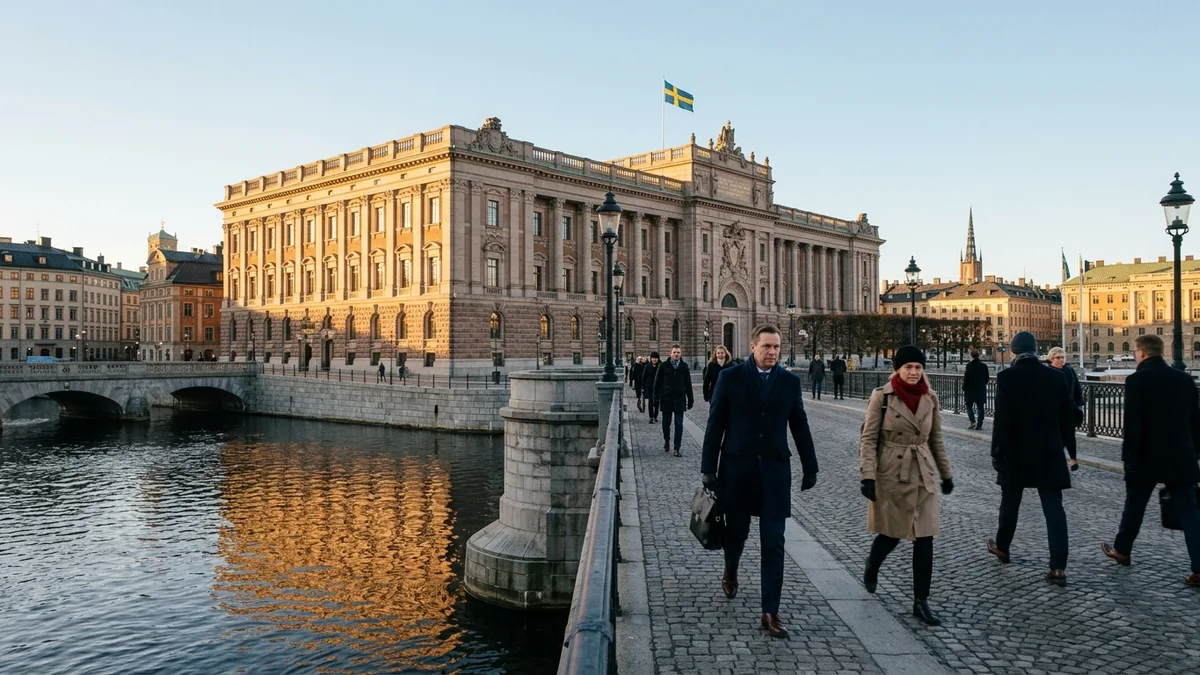
Photo: Melker Dahlstrand / Sveriges riksdag