 Sunil Rao
Sweden's post-election political deadlock hit a major turning point on Sunday, November 15, 2026: Centre Party leader Elisabeth Thand Ringqvist announced that her party will move forward with government negotiations led by Social Democrat Magdalena Andersson, turning down caretaker Prime Minister Ulf Kristersson's centre-right offer.
If you live or work in Sweden and find Swedish coalition politics confusing, you are not alone. Since the September 2026 parliamentary election, Sweden has been stuck without a majority government, running on a caretaker administration while party leaders traded proposals behind closed doors.
Sunday's decision does not mean Magdalena Andersson is Prime Minister yet. Instead, it clears the first major hurdle by narrowing the race down to one active negotiation track - though one huge disagreement between the Centre Party and the Left Party still stands in the way.
At a Glance: What Happened on November 13 to 15
- The Friday deadline (November 13): Centre Party leader Elisabeth Thand Ringqvist had asked both Magdalena Andersson (Social Democrats) and Ulf Kristersson (Moderates) to submit formal "total packages" (totalpaket) spelling out their policy promises and how they plan to secure a majority in parliament.
- Sunday's decision (November 15): After reviewing both proposals, the Centre Party announced it is choosing the Social Democrats' package as the basis for further negotiations, rejecting the Moderate-led alternative that relied on Sweden Democrats (SD) support.
- What Andersson's package included: According to Swedish media reports, the Social Democrats' offer included proposals to reduce or abolish the sick-pay waiting-day deduction (karensavdrag), strengthen property rights for private forest owners, and add constitutional protection for public service media.
- Andersson's response: Magdalena Andersson welcomed the decision and said she wants to move immediately into the next phase of talks involving the Social Democrats (S), the Centre Party (C), the Green Party (MP), and the Left Party (V).
Why Sweden's Parliament Is Stuck: Plain-English Party Guide
Unlike countries with a two-party system, Sweden's parliament (the Riksdag) has eight parties, and no single party comes close to winning 50% of the seats on its own. To govern, a Prime Minister does not need a majority to vote "yes" - under Sweden's "negative parliamentarism" rule, they simply need fewer than half of the 349 MPs to vote "no."
| Party / Leader | Role in Current Talks | Main Condition or Red Line |
|---|---|---|
| Social Democrats (S) Magdalena Andersson | Leading the centre-left track | Wants to form a government with C and MP, backed in parliament by V. |
| Centre Party (C) Elisabeth Thand Ringqvist | Kingmaker in the middle | Picked S over M, but demands V stay out of cabinet and wants clear budget financing. |
| Green Party (MP) | Expected coalition partner | Part of Andersson's preferred S-C-MP cabinet framework; must back the joint deal. |
| Left Party (V) Nooshi Dadgostar | Needed for a parliamentary majority | Insists on getting ministerial posts in the cabinet in exchange for voting yes. |
| Moderates (M) Ulf Kristersson | Caretaker Prime Minister | Submitted a rival package backed by right-wing partners; still holds an exploratory mandate to report to the Speaker. |
The Big Remaining Obstacle: The Left Party vs. The Centre Party
Even though Sunday's announcement is a breakthrough for Magdalena Andersson, a final government deal is far from guaranteed. Elisabeth Thand Ringqvist made clear on November 15 that heavy negotiations remain on both policy direction and how everything will be paid for.
The single toughest clash is over who gets to sit around the cabinet table:
- The Centre Party's red line: Centerpartiet is an economically centrist, pro-business, and rural-focused party. Its leadership insists that the Left Party (Vänsterpartiet) must drop its demand for cabinet ministers for talks to succeed.
- The Left Party's demand: Left Party leader Nooshi Dadgostar and her party have repeatedly stated that they are no longer willing to support a Social Democratic government from the sidelines without holding ministerial seats themselves.
This puts Magdalena Andersson in a classic Swedish balancing act. Without the Centre Party, she has no majority. Without the Left Party's votes in the Riksdag, she has no majority either. Over the coming days, negotiators will have to test whether a compromise on policy influence, budget negotiations, or written parliamentary agreements can satisfy both sides without breaking either party's core promise to its voters. Even if a deal is reached, the final parliamentary vote requires careful arithmetic, because every single seat counts when margins in the Riksdag are this tight.
What Happens Next in the Riksdag?
In Sweden, the Speaker of the Riksdag (talmannen), Andreas Norlén, acts as the neutral referee who hands out exploratory mandates (sonderingsuppdrag) to party leaders and eventually proposes a Prime Minister candidate for a parliamentary vote.
- Speaker updates: Caretaker Prime Minister Ulf Kristersson is scheduled to report back to Speaker Andreas Norlén on his exploratory mandate, while the Speaker weighs whether to formally hand the negotiating task to Magdalena Andersson.
- Four-party policy & budget talks: If Andersson gets the formal green light, S, C, MP, and V must hammer out a concrete policy agreement and a financing plan that adds up in kronor and öre.
- Formal Prime Minister vote (Statsministeromröstning): Only when the parties believe they will not be voted down by 175 or more MPs does the Speaker put a Prime Minister nominee to an official vote in the Riksdag chamber.
What This Means for Everyday Residents & Your Wallet
NordDaily Practical Takeaway: Nothing in your paycheck, tax bracket, or pension changes overnight because of Sunday's announcement. Sweden's bare-bones 2027 caretaker budget was already handed to parliament on November 12, which keeps existing laws and inflation-linked benefits running automatically.
However, if Andersson successfully forms an S-C-MP government in the coming weeks, her coalition could introduce an amending budget (ändringsbudget) early in 2027. Watch closely for proposals mentioned in the talks - especially any changes to the sick-pay waiting-day deduction (karensavdrag), which directly affects how much pay you lose when calling in sick for a day.
For ordinary households, expats, and employees in Sweden, here are the three practical things to keep in mind while talks continue:
- Sick pay (karensavdrag): Under current 2026 rules, employees lose an amount equal to 20% of an average week's sick pay on the first day of illness. Cutting or scrapping this deduction was one of the headline items in the Social Democrats' package, though it still needs full parliamentary backing to become law.
- Taxes and benefits on January 1, 2027: Automatic inflation adjustments - such as the 2027 Price Base Amount (prisbasbelopp) of SEK 60,500, pension indexing, and tax bracket thresholds - proceed automatically regardless of coalition talks.
- If talks fail: Under Sweden's constitution, if the Riksdag rejects four Prime Minister nominees proposed by the Speaker, Sweden automatically triggers a snap election (extra val). For now, Sunday's move makes a negotiated solution more likely than before, even though tough hurdles remain.
Official Sources
- Riksdagen (Swedish Parliament): Official updates on the 2026 government formation process and Speaker Andreas Norlén's exploratory mandates.
- Centerpartiet & Socialdemokraterna: Party statements from November 13 to November 15, 2026 by Elisabeth Thand Ringqvist and Magdalena Andersson regarding the "total packages" and next-phase coalition talks.
Frequently asked questions
Did Sweden get a new Prime Minister on November 15, 2026?
No. The Centre Party's November 15 announcement means it has chosen to negotiate with Social Democrat leader Magdalena Andersson rather than Moderate leader Ulf Kristersson. A new government still has to agree on policy and financing and pass a formal vote in the Riksdag.
Why is the Centre Party (Centerpartiet) so important right now?
Following the September 2026 election, neither Sweden's centre-left bloc nor its centre-right bloc holds a majority on its own. Because the Centre Party sits in the middle, its backing is essential for either side to form a viable government.
What is the biggest remaining obstacle to a new Swedish government?
The biggest clash is over the Left Party (Vänsterpartiet). Left Party leader Nooshi Dadgostar has demanded ministerial seats in the cabinet, while the Centre Party insists that the Left Party must drop its demand for cabinet posts before a deal can succeed.
What does this mean for the 2027 Swedish budget and everyday households?
Until a new government is voted into office, Sweden runs on the bare-bones 2027 caretaker budget presented on November 12. Once a new government takes office, it can propose an amending budget with new tax, sick-pay, or spending changes.
Estimate only. Talk to a qualified adviser before acting on anything here.
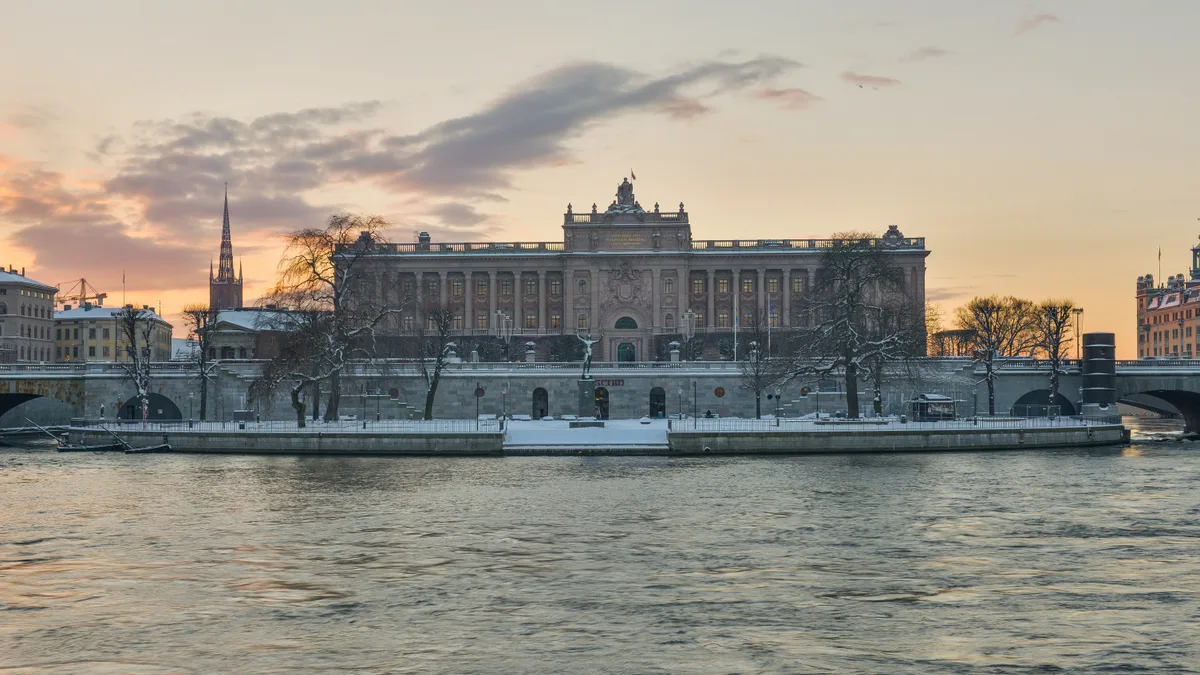
Photo: Wikimedia Commons / Arild Vågen (CC BY-SA 3.0)