 Sunil Rao
On 29 October 2026, Sweden's central bank, Sveriges Riksbank, formally called on the Swedish Government to introduce a strict 10,000 SEK upper limit on cash payments in retail trade (kontantgräns på 10 000 kronor i handeln) when the European Union's new Anti-Money Laundering Package takes effect in July 2027.
In its official consultation response (remissvar) on the Government's legislative memorandum adapting Swedish law to the EU Anti-Money Laundering Package (EU:s penningtvättspaket), Riksbanken welcomed the overarching European reforms but argued that the EU's default ceiling of 10,000 EUR (roughly 115,000 SEK) is far too high for Sweden's heavily digitized economy. Instead, Riksbanken urged the Ministry of Finance to exercise the explicit national opt-down clause in the EU regulation and cap cash transactions in Swedish commerce at 10,000 SEK.
For international residents, newcomers, and business owners in Sweden - especially those arriving from countries where paying for used cars, furniture, electronics, or home renovations in physical banknotes is still routine - understanding how Sweden's cash laws and bank anti-money laundering (AML) rules operate is essential. Here is our complete breakdown of Riksbanken's 29 October 2026 proposal, how it interacts with the central bank's 1,000 SEK crisis cash recommendation, and what happens if you try to spend or deposit large sums of cash in Sweden.
Key Takeaways: Riksbanken's 10,000 SEK Cash Limit Proposal (29 October 2026)
- Official Consultation Response: Published by Sveriges Riksbank on 29 October 2026 in response to the Swedish Government's memorandum on the EU Anti-Money Laundering Package (EU:s penningtvättspaket).
- 10,000 SEK vs. 10,000 EUR: While the new EU AML Regulation sets a baseline EU-wide ban on commercial cash payments exceeding 10,000 EUR starting in July 2027, it allows Member States to set a lower national threshold. Riksbanken recommends setting Sweden's threshold at 10,000 SEK.
- Why 10,000 SEK? Riksbanken concludes that a 10,000 SEK cap causes virtually zero disruption to legitimate everyday payments in Sweden's digital economy while curbing money laundering (penningtvätt), tax evasion (skatteundandragande), and organized economic crime.
- Crisis Cash Unaffected: The proposed 10,000 SEK commercial ceiling is ten times larger than Riksbanken's household crisis preparedness recommendation of 1,000 SEK per adult in small denominations for emergency food, medicine, and fuel.
1. Inside Riksbanken's 29 October 2026 Consultation Response
In 2024, the European Parliament and the Council of the European Union adopted the landmark EU Anti-Money Laundering Package, centered on the directly applicable EU Anti-Money Laundering Regulation (Regulation EU 2024/1624) and the Sixth Anti-Money Laundering Directive (AMLD6), which enter into application across all 27 EU Member States in July 2027.
A centerpiece of the EU regulation is a union-wide prohibition on persons trading in goods or providing services accepting or making cash payments of more than 10,000 EUR (or the equivalent in national currency) in a single transaction or in several linked transactions. Crucially, however, Article 80 of the EU regulation explicitly empowers individual Member States to maintain or introduce lower national maximum limits after consulting their central bank.
In its 29 October 2026 filing, Riksbanken made two clear points to the Swedish Government:
- 10,000 EUR Is Out of Step with Swedish Payment Reality: Across the eurozone, countries differ sharply in cash usage. While countries such as Germany and Austria historically resisted low cash caps, several EU states (including France, Spain, Italy, Belgium, and Denmark) already enforce much stricter national cash ceilings ranging from 1,000 EUR to 3,000 EUR (or 15,000 DKK in Denmark). In Sweden - where fewer than 1 in 10 retail purchases are made in cash and large legitimate purchases are settled almost exclusively via bank transfer, card, or Swish - a 10,000 EUR (~115,000 SEK) limit would leave a wide door open for criminal cash settlement.
- 10,000 SEK Strikes the Right Balance: Setting the statutory commercial cash ceiling at 10,000 SEK protects consumers who rely on cash for groceries, pharmacy medicines, and everyday household shopping while preventing high-value goods, jewelry, electronics, construction services, and vehicles from being used to launder illicit cash or evade VAT (moms) and payroll taxes.
2. How Cash Rules in Sweden Compare: Current Law vs. July 2027 EU AML Package
Many expats are surprised to learn how Sweden's current legal framework treats cash. Here is a side-by-side comparison of the rules in force today versus the July 2027 EU AML framework and Riksbanken's proposed 10,000 SEK threshold:
| Payment Scenario | Current Swedish Law (2026) | July 2027 EU AML Default | Riksbanken's 29 Oct 2026 Proposal for Sweden |
|---|---|---|---|
| Maximum Cash Payment to a Business / Merchant | Traders accepting 5,000 EUR (~57,500 SEK) or more in cash must register with Länsstyrelsen and run strict AML/KYC checks under Penningtvättslagen (2017:630) | Hard statutory ban above 10,000 EUR (~115,000 SEK) in a single or linked commercial transaction | Hard statutory ban above 10,000 SEK in a single or linked commercial transaction |
| Can a Private Shop or Restaurant Refuse Cash Entirely? | Yes, under freedom of contract (avtalsfrihet), if the store clearly posts a "Kontantfri butik" sign before purchase | Unchanged by the AML cap (governed by national legal tender rules) | Riksbanken separately supports a statutory duty for essential grocery and pharmacy outlets to accept cash |
| Public Healthcare Fees & Public Authorities | Protected by administrative law and regional court precedents requiring a cash or invoice payment option | Protected | Protected |
| Recommended Household Crisis Cash ("Krigskassa") | 1,000 SEK per adult in small denominations (20 kr, 50 kr, 100 kr, 200 kr) for 7 days of offline preparedness | Unaffected | Fully compatible (10,000 SEK cap is 10x the 1,000 SEK emergency buffer) |
3. Why Riksbanken Simultaneously Defends Small Cash AND Wants to Ban Big Cash
At first glance, some readers wonder whether Riksbanken's two October 2026 announcements contradict each other: on one hand, First Deputy Governor Aino Bunge and Riksbanken's Payment Report remind every adult in Sweden to keep 1,000 SEK in physical cash at home and urge parliament to require pharmacies and grocery stores to accept cash; on the other hand, Riksbanken wants to ban cash payments over 10,000 SEK.
In reality, the two policies are designed to work together:
- Protecting Small-Value Cash for Crisis Preparedness & Digital Exclusion: Cash is the only payment method that works without electricity, mobile networks, or bank servers. For elderly citizens, newcomers waiting for their first Swedish ID card and BankID, and households facing a power outage, being able to buy 300 SEK to 1,500 SEK of food, baby formula, or prescription medicine in cash is a vital societal safety net.
- Eliminating High-Value Cash in the Shadow Economy: According to the Swedish Police Authority (Polismyndigheten) and the Swedish Economic Crime Authority (Ekobrottsmyndigheten), high-denomination cash transactions over 10,000 SEK are overwhelmingly concentrated in the criminal economy, undeclared labour (svartarbete), and trade-based money laundering. By capping retail cash payments at 10,000 SEK - similar to neighbouring Denmark's 15,000 DKK cash ban - Sweden removes criminal demand for large cash transactions while keeping everyday banknotes accessible.
Real-World Case Study: Moving to Sweden With Foreign Cash Savings vs. Electronic Bank Transfers
The Scenario: Lukas (36), a mechanical engineer relocating to Malmö from Germany, sells his used car in Munich for 8,500 EUR in cash before moving to Sweden. He considers bringing the physical euro banknotes to Sweden, exchanging them at a currency bureau, and depositing the Swedish kronor into his new Swedish bank account or using the cash to buy furniture.
Why Bringing Physical Cash to Sweden Creates Major Friction - And What Lukas Should Do Instead:
- Swedish Bank Deposit Freezes: Even if Lukas exchanges 8,500 EUR (~98,000 SEK) at a licensed exchange office (where stringent KYC and source-of-funds checks already apply), Swedish commercial banks (SEB, Nordea, Handelsbanken, Swedbank) routinely refuse to accept large physical cash deposits from new customers or block the account under the Money Laundering Act (Penningtvättslagen) because physical banknotes break the digital audit trail between the German car buyer and the Swedish bank.
- Retail Refusal & Proposed 10,000 SEK Cap: Most major furniture and electronics stores in Sweden (including IKEA and major appliance chains) operate cashless checkouts or strict cash ceilings, and under Riksbanken's proposed 10,000 SEK limit, no Swedish merchant would legally be allowed to accept a cash purchase above 10,000 SEK from July 2027.
- The Clean Solution: Lukas deposits the 8,500 EUR directly into his German bank account in Munich (providing the German Kaufvertrag car sale contract to his German bank) and sends a digital SEPA transfer from his own German IBAN to his new Swedish IBAN. That preserves an unbroken electronic paper trail that satisfies Swedish bank AML compliance in minutes.
4. Five Practical Cash & AML Rules Every Expat in Sweden Must Know Today
Whether you are shopping, selling second-hand items on Blocket, or managing your bank accounts in Sweden, follow these five practical rules to avoid payment refusals or bank compliance freezes:
- Never Bring Foreign Savings to Sweden as Physical Cash: Always keep your relocation funds inside the regulated banking system and transfer them electronically via SEPA or SWIFT from an account in your own name. Even declaring 10,000 EUR+ at Swedish Customs (Tullverket) at the border does not compel a Swedish bank to accept a physical cash deposit later.
- Use Swish or Instant Bank Transfer for Second-Hand Sales (Blocket / Marketplace): If you sell a bicycle, stroller, or car privately in Sweden, ask the buyer to pay via Swish or an instant in-branch/mobile bank transfer rather than physical cash, and save a screenshot of the listing and message thread in case your bank's automated AML monitoring asks about the incoming payment.
- Keep Your 1,000 SEK Emergency Cash Buffer in Small Notes: Follow Riksbanken's crisis preparedness guideline by keeping roughly 1,000 SEK per adult at home in 20 kr, 50 kr, 100 kr, and 200 kr banknotes (avoid 500 kr and 1,000 kr notes, as grocery stores running on emergency offline registers quickly run out of change).
- Know How to Redeem Old or Invalid Banknotes (Lösa in ogiltiga sedlar): If you find older Swedish banknotes that have ceased to be legal tender, Riksbanken's banknote redemption serviceredeems invalid banknotes by bank transfer (98.5% approval rate according to Riksbanken's October 2026 statistics) against a 200 SEK administrative fee, provided you can document how you acquired them.
- Watch for the Government's Final AML Bill Ahead of July 2027: Following the close of the consultation round on the EU AML Package memorandum, the Ministry of Finance will finalize the government proposition for the Riksdag ahead of the July 2027 entry into force.
The NordDaily Banking & AML Playbook: In Sweden, physical cash is for two things only: small everyday purchases (under a few thousand kronor) and your household 7-day crisis kit (1,000 SEK per adult). For everything else - rent deposits, used cars, furniture, and transferring savings from abroad - keep 100% of the transaction digital so you have an indisputable bank-to-bank audit trail. If you are planning to transfer money to or from a Swedish bank account, run your transaction through our interactive Swedish Bank AML & Source-of-Funds Checker first to see exactly which documents your bank will request.
Official Sources & Statutory References
- Sveriges Riksbank Official Announcement & Consultation Response (29 October 2026): Riksbanken - Inför en kontantgräns på 10 000 kronor (Remissvar angående promemorian EU:s penningtvättspaket)
- Sveriges Riksbank Payment & Cash Statistics (October 2026): Riksbanken - Betalningar och kontanter i Sverige 2026
- Swedish Money Laundering Act (Penningtvättslagen 2017:630): Lag (2017:630) om åtgärder mot penningtvätt och finansiering av terrorism - Sveriges Riksdag
- EU Anti-Money Laundering Regulation (Regulation EU 2024/1624): Regulation (EU) 2024/1624 on the prevention of the use of the financial system for the purposes of money laundering or terrorist financing
Related articles
Frequently asked questions
What cash payment limit did Sveriges Riksbank propose on 29 October 2026?
On 29 October 2026, Sveriges Riksbank submitted its official consultation response (remissvar) on the Swedish Government's legislative memorandum implementing the EU Anti-Money Laundering Package (EU:s penningtvättspaket). Riksbanken urged the Government to set a national cap of 10,000 SEK on cash payments in commercial trade (kontanta betalningar i handeln), rather than using the EU's default ceiling of 10,000 EUR (approximately 115,000 SEK).
When does the new EU Anti-Money Laundering (AML) cash limit take effect?
The European Union's new Anti-Money Laundering Regulation (Regulation EU 2024/1624) and accompanying Swedish adaptation laws enter into force in July 2027 (specifically 10 July 2027 across the EU). Under the EU regulation, Member States may adopt a lower national cash payment threshold than 10,000 EUR to combat money laundering, tax evasion, and organized economic crime.
Does a 10,000 SEK cash payment limit conflict with Riksbanken's 1,000 SEK emergency cash recommendation?
No. Riksbanken's crisis preparedness recommendation - recently reiterated by First Deputy Governor Aino Bunge - advises every adult in Sweden to keep roughly 1,000 SEK in physical banknotes of smaller denominations at home to cover one week of essential groceries, pharmacy items, and fuel during a severe power or internet outage. A 10,000 SEK limit on single commercial purchases is ten times higher than the household crisis buffer and therefore does not restrict everyday or emergency cash purchases.
What are the current rules for paying with cash in Sweden before July 2027?
Currently, Sweden does not have a single universal statutory ban on cash retail payments below 5,000 EUR, but two rules apply in practice: (1) Under freedom of contract (avtalsfrihet), private shops, restaurants, and businesses can legally refuse cash altogether provided they display a clear 'Kontantfri butik' (Cashless store) sign before you enter into a purchase; and (2) Under the Swedish Money Laundering Act (Penningtvättslagen 2017:630), traders in goods who accept cash payments of 5,000 EUR or more must register with the County Administrative Board (Länsstyrelsen) and perform strict Customer Due Diligence (kundkännedom).
Would the 10,000 SEK cash limit apply to private sales between two individuals (for example, on Blocket)?
Under the EU Anti-Money Laundering Regulation, the mandatory cash payment cap applies to transactions where at least one party is acting in a professional or commercial capacity (persons trading in goods or providing services). Purely private, non-professional sales between two private consumers are generally outside the commercial trader prohibition, though depositing large amounts of cash from a private sale into a Swedish bank account will still trigger rigorous source-of-funds checks by your bank.
How much cash can I deposit into a Swedish bank ATM (Bankomat) without documentation?
Bankomat AB, which operates cash deposit machines for Sweden's major banks (Handelsbanken, Nordea, SEB, Swedbank, and Danske Bank), applies rolling deposit limits (typically around 10,000 SEK within a 7-day rolling window depending on your card-issuing bank). Furthermore, under Penningtvättslagen, your bank can freeze or reject cash deposits of any size if you cannot document the lawful origin of the banknotes with an official receipt, withdrawal slip, or signed sales contract.
Estimate only. Talk to a qualified adviser before acting on anything here.
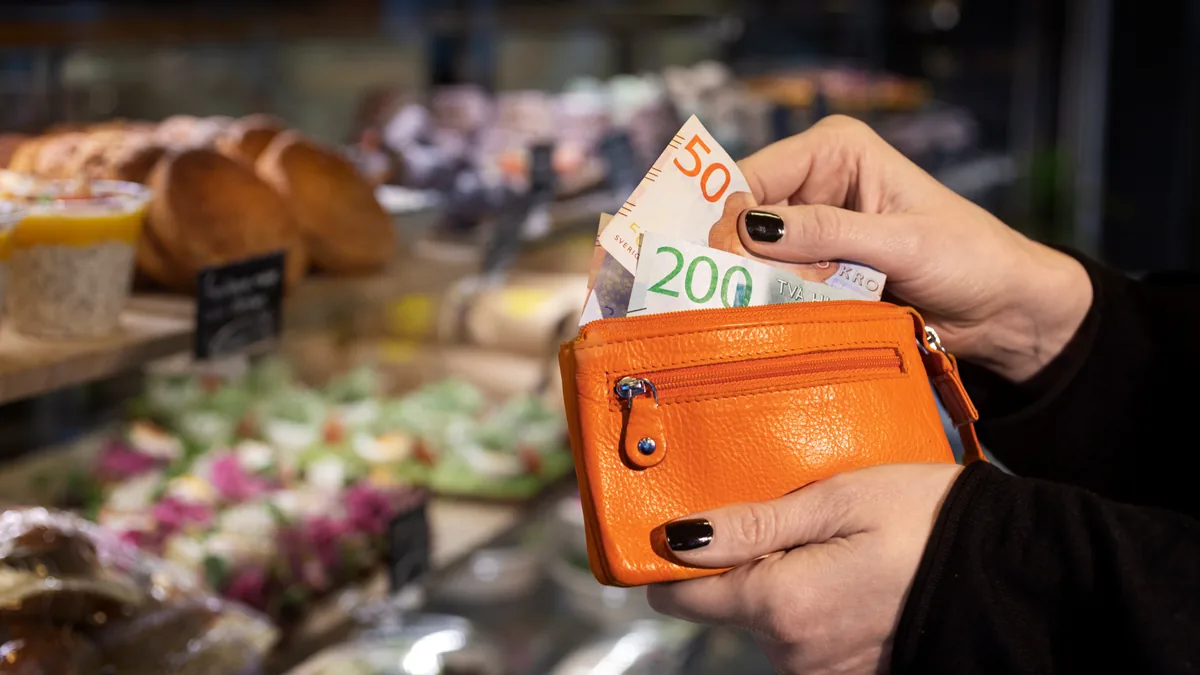
Photo: Sveriges Riksbank / Pressbild