 Sunil Rao
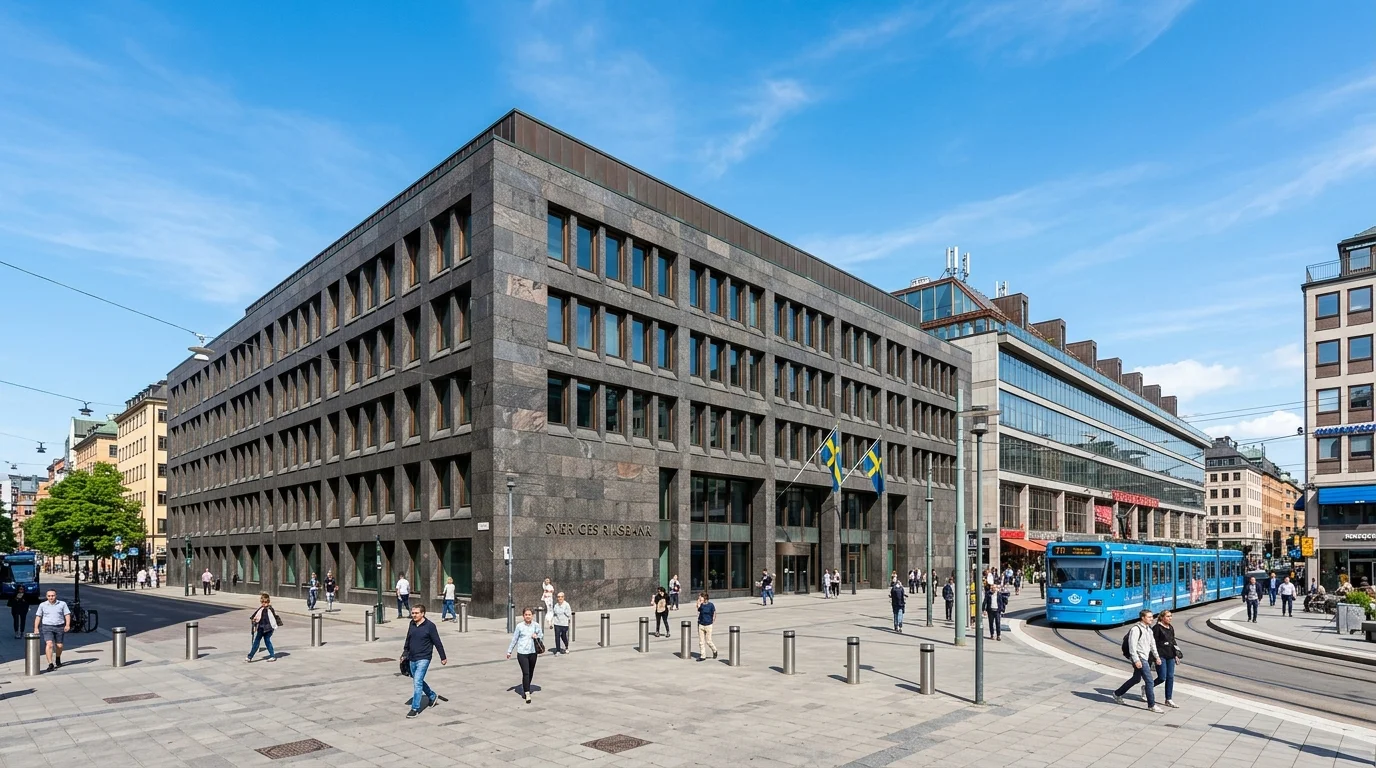
On August 19, 2026, the Executive Board of Sveriges Riksbank convened in Stockholm for its fifth monetary policy meeting of the year. In a unanimous decision, the central bank resolved to leave the benchmark policy rate (styrränta) unchanged at 1.75%. While financial markets anticipated the rate pause, the official meeting minutes released today reveal intense boardroom deliberations regarding underlying services inflation, Swedish krona (SEK) exchange rate vulnerabilities, and household debt sensitivity.
For Sweden’s mortgage holders, prospective home buyers, and expat residents, this decision signals an extended period of interest rate stabilization following the aggressive rate-cutting cycles of 2024 and 2025. This comprehensive analysis breaks down the governors' deliberations, macroeconomic forecasts, commercial mortgage lending benchmarks, and housing market trends.
1. Executive Board Deliberations: Inside the Boardroom
The minutes reveal nuanced perspectives among the five board members - Governor Erik Thedéen, First Deputy Governor Anna Breman, and Deputy Governors Aino Bunge, Per Jansson, and Martin Flodén:
- Governor Erik Thedéen: Emphasized that monetary policy is operating effectively in neutral territory. While headline CPIF inflation has converged close to the 2.0% target, Thedéen warned that geopolitical volatility and labor market wage negotiations require central bank agility.
- First Deputy Governor Anna Breman: Highlighted that domestic demand is recovering moderately. Breman noted that Swedish households have shown resilience to higher borrowing costs, but real disposable income growth remains fragile.
- Deputy Governor Per Jansson: Reaffirmed that while the policy rate remains comfortably below the 4.0% peak of 2023-2024, the central bank should avoid rushing into further easing until international central banks (the European Central Bank and US Federal Reserve) clarify their rate paths.
- Deputy Governor Aino Bunge: Pointed to the stability of commercial real estate financing and corporate balance sheets, noting that bankruptcy rates among construction firms have stabilized.
2. Inflation Dynamics: Anchored Near the 2.0% Target
According to Statistics Sweden (SCB) data reviewed by the Board, Sweden’s headline inflation metrics have stabilized solidly:
| Inflation Metric | July 2026 Actual | Riksbank Target | Policy Implication |
|---|---|---|---|
| CPIF (Headline with fixed interest) | 2.1% | 2.0% | Fully converged within target tolerance band. |
| CPIF-XE (Excl. Energy & Food) | 2.3% | 2.0% | Core services inflation proving slightly sticky. |
| CPI (Consumer Price Index) | 1.8% | N/A | Lower interest costs pulling broad CPI below CPIF. |
3. Swedish Mortgage Market Impact & Snittränta Benchmarks
With the Riksbank holding the policy rate at 1.75%, commercial bank funding costs (STIBOR 3M) have settled near 2.00%–2.10%. Commercial banks - including SBAB, Swedbank, SEB, Handelsbanken, and Nordea - are offering competitive mortgage discount margins:
| Mortgage Fixation Period | List Price (Listränta) | Average Discount (Ränterabatt) | Net Effective Rate (Snittränta) |
|---|---|---|---|
| 3-Month Variable (Rörlig) | 4.25% | -1.25% to -1.40% | 2.85% - 3.00% |
| 1-Year Fixed (Bunden 1 år) | 3.95% | -1.10% to -1.25% | 2.70% - 2.85% |
| 3-Year Fixed (Bunden 3 år) | 4.05% | -1.15% to -1.30% | 2.75% - 2.90% |
| 5-Year Fixed (Bunden 5 år) | 4.20% | -1.20% to -1.35% | 2.85% - 3.00% |
4. Swedish Krona (SEK) Dynamics vs Global Central Banks
A central topic in the August deliberations was the Swedish krona's exchange rate against the Euro (EUR/SEK ~11.15) and US Dollar (USD/SEK ~10.25). The Board observed that a premature rate reduction could trigger currency depreciation, re-importing inflation on imported foodstuffs, consumer electronics, and foreign fuel.
The Executive Board noted that maintaining a slight interest rate differential alignment with the ECB preserves krona purchasing power, keeping imported inflation under strict control.
4. Worked Case Study: Policy Rate Cut Impact on Monthly Mortgage Costs
Case Study: SEK 3,500,000 Mortgage on a 50 bps Rate Reduction
Profile: Lisa and Martin have a SEK 3,500,000 variable mortgage (rörlig ränta) in Stockholm with a negotiated 1.0% bank discount.
Mathematical Savings Calculation:
• Annual Interest Reduction (0.50% cut):
3,500,000 × 0.005 = SEK 17,500/year• Monthly Gross Savings: SEK 1,458/month
• Net Monthly Savings after 30% Ränteavdrag: SEK 1,021/month in extra household cash
5. Housing Market Outlook & BRF Finances for Autumn 2026
The stabilization of interest rates at 1.75% is having two distinct positive effects across Swedish residential property:
- Transaction Volumes: Sales volumes in Stockholm, Gothenburg, and Malmö have rebounded to pre-2022 seasonal averages, with bidding premiums returning for well-maintained family homes and apartments.
- BRF Association Balance Sheets: Housing cooperatives (bostadsrättsföreningar) holding high debt (>SEK 10,000/sqm) face manageable refinancing costs compared to 2023 peaks, but board treasurers are maintaining disciplined maintenance reserves.
- New Construction Starts: Residential construction has shown modest initial signs of stabilization, although starts remain subdued compared to 2021 historical highs.
6. Actionable Decision Roadmap for Borrowers & Expats
- Audit Your Ränterabatt Expiry: Mortgage rate discounts expire annually. If your negotiated discount has expired, your rate will revert to the bank's high list price. Contact your bank immediately with current Snittränta comparison data.
- Request Your Amorteringsunderlag: When shopping for better mortgage rates, request your official amortization certificate (amorteringsunderlag). This legally signals to your bank that you are prepared to switch lenders.
- Run KALP Affordability Tests: If planning to buy a home this autumn, test your borrowing capacity under Finansinspektionen's mandatory 3% + 1% amortization rules.
- Review Fixed vs Variable Mix: Many financial advisors recommend splitting mortgage debt (e.g. 50% 3-month variable and 50% 3-year fixed) to lock in rates near 2.75% while keeping flexibility.
7. Historical Context: The 2022-2026 Monetary Policy Cycle
To understand the strategic significance of the August 2026 rate pause at 1.75%, borrowers must examine the broader 4-year monetary cycle. Between mid-2022 and late 2023, the Riksbank executed one of the fastest tightening campaigns in modern Nordic history, raising the policy rate from 0.00% to a peak of 4.00% to combat post-pandemic inflation spikes.
As headline inflation receded rapidly throughout 2024 and 2025, the central bank implemented a series of calculated 25 and 50 basis point cuts. The current 1.75% benchmark represents what economists define as the Swedish economy's long-run "neutral interest rate" (den neutrala räntan) - a level that neither stimulates nor restricts domestic economic output.
8. Fixed vs Variable Rate Strategy: 2026 Decision Matrix
Swedish home buyers and existing mortgage holders face the classic dilemma of choosing between 3-month variable borrowing (rörlig ränta) and fixed terms (bunden ränta for 1, 3, or 5 years). The August meeting minutes provide clear tactical indicators:
- The Case for 3-Month Variable (2.85% - 3.00%): Provides maximum liquidity and flexibility. If inflation drops further in late 2026, variable borrowers benefit immediately from lower interest charges without paying interest rate differential penalties (ränteskillnadsersättning) if selling property.
- The Case for 3-Year Fixed (2.75% - 2.90%): Currently priced at a slight discount to variable rates due to an inverted yield curve. Highly recommended for first-time buyers and households with tight debt-to-income ratios seeking absolute budgetary predictability.
- The Split Mortgage Approach (Dela lånet): Dividing a SEK 3,000,000 mortgage into two tranches - SEK 1.5M on 3-month variable and SEK 1.5M on 3-year fixed - balances cash flow certainty with market agility.
9. Step-by-Step Mortgage Rate Negotiation Checklist
- Step 1 - Download Your Bank's Snittränta: Look up your lender's officially published average actual rate (snittränta) from the previous month. This gives you empirical leverage against inflated list prices.
- Step 2 - Request Your Amorteringsunderlag: Submit a formal request for your amortization certificate via online banking. This alerts the retention desk that you are actively shopping your loan.
- Step 3 - Solicit Competing Offers: Request binding mortgage offers from digital challenger banks (such as SBAB, Landshypotek, Stabelo, and Hypoteket) which offer transparent, non-negotiated discounts.
- Step 4 - Leverage Salary & Insurance Loyalty: Offer to move everyday transactional accounts, occupational pensions, or home insurance (hemförsäkring) to secure an additional 0.10%–0.15% discount margin.
- Step 5 - Calendar Your Annual Expiry: Set a recurring calendar reminder 30 days before your 12-month discount agreement expires to re-negotiate before your rate automatically reverts to the standard list price.
NordDaily Tips
Key Takeaway: With the Riksbank policy rate firmly anchored at 1.75%, borrowers are in an optimal position to negotiate variable mortgage rates down to 2.85%–3.00%. Never accept a bank's list price without demanding at least a 1.20% discount margin. Use our interactive KALP Mortgage Calculator to calculate your exact monthly costs and stress test your household finances.
Sources
- Sveriges Riksbank - Protokoll från penningpolitiska mötet den 19 augusti 2026
- Statistiska centralbyrån (SCB) - Konsumentprisindex (KPIF)
- Finansinspektionen - Bolånerapport och amorteringskrav 2026
Related articles
Frequently asked questions
What is the Riksbank policy rate (styrränta) in 2026?
Sweden's central bank (Sveriges Riksbank) sets the policy rate to steer inflation toward the 2% CPIF target, directly dictating variable mortgage rates (rörlig ränta) and savings yields.
How does the Riksbank policy rate impact Swedish mortgages?
Swedish 3-month variable mortgage rates track the policy rate closely, typically settling around 0.8% to 1.2% above the policy rate after negotiated bank discounts.
How often does the Riksbank hold monetary policy meetings?
The Executive Board of the Riksbank holds eight scheduled monetary policy meetings per calendar year to review inflation data and adjust the policy rate.
Estimate only. Talk to a qualified adviser before acting on anything here.
Photo: Anna Andersson / imagebank.sweden.se