 Sunil Rao
Why does a country famous for world-leading consumer technology still struggle to let a hospital doctor in Gothenburg read a patient's medical chart from Stockholm? On Monday, 9 November 2026, the Swedish eHealth Agency (E-hälsomyndigheten) presented its long-awaited national investigation into how Sweden's 21 healthcare regions procure and manage electronic health record systems (vårdinformations- och journalsystem). At the press briefing, Minister for Social Affairs Jakob Forssmed (KD) bluntly termed the findings a "disaster inquiry" (haveriutredning).
The report follows years of costly regional IT failures - most notably in Region Västra Götaland (where the chaotic rollout of the US-built Millennium system had to be halted and scrapped after costing taxpayers billions of kronor and causing severe clinical disruption) and repeated multi-year delays in Region Skåne's SDV transition. According to E-hälsomyndigheten, Sweden's regions have locked themselves into giant, monolithic IT contracts that stifle competition, burden doctors and nurses with administrative clicks, and trap patient data inside regional silos.
For international residents, students, and families living in Sweden, understanding how Sweden's decentralized healthcare IT actually works - and how to make sure your medical history, prescriptions, and 2026 high-cost protection caps (högkostnadsskydd) follow you when you travel or move between regions - can save you both money and dangerous clinical delays. Here is our complete guide.
1. Inside the 9 November 2026 "Disaster Inquiry" (Haveriutredning): What Went Wrong in Sweden's Regions?
Commissioned by the Ministry of Health and Social Affairs (Socialdepartementet), E-hälsomyndigheten's 9 November 2026 report analyzed the procurement structure, vendor concentration, and lifecycle costs of the core clinical IT platforms across all 21 Swedish regions.
Minister Jakob Forssmed and the agency highlighted four systemic failures that have cost Swedish taxpayers billions of kronor while frustrating frontline medical staff:
- The Failure of Monolithic "Mega-Procurements": Instead of buying modular, interoperable software components that plug into a shared national standard, several Swedish regions attempted to procure a single all-encompassing "mega-system" intended to replace dozens of specialized hospital, primary care, and laboratory tools overnight. When those monolithic implementations failed (as seen with Millennium in Västra Götaland), regions suffered multi-billion-kronor write-offs and fell back onto 20-to-30-year-old legacy systems.
- Severe Market Concentration and Vendor Lock-In: Following the collapse of alternative rollouts, nearly the entire Swedish regional healthcare market has consolidated around a tiny handful of dominant systems (primarily Cambio Cosmic across the majority of regions, alongside TakeCare in Region Stockholm and Region Gotland). Proprietary data formats make it prohibitively expensive for a region to switch suppliers or plug in modern AI diagnostic tools.
- 21 Regional Silos + 290 Municipal Care Silos: Because regions run hospital and primary care (vårdcentraler) while Sweden's 290 municipalities run elderly care and home nursing (hemsjukvård), doctors and municipal nurses frequently cannot read each other's patient notes in real time without faxing, phoning, or logging into separate portals.
- The Government's 2026-2027 Reform Roadmap: In response to the 9 November 2026 report, Social Affairs Minister Jakob Forssmed announced that the state will step in with much stronger national governance: mandating open national interoperability standards (led by E-hälsomyndigheten), requiring modular procurement architectures rather than monolithic all-in-one contracts, and building out Sweden's National Digital Infrastructure for Healthcare so patient data follows the individual across regional borders by law.
| Swedish Healthcare Region / System Layer | Primary Electronic Record System (2026) | Key Findings in 9 Nov 2026 Audit | What Expats & Patients Must Know |
|---|---|---|---|
| Region Stockholm & Region Gotland | TakeCare (CompuGroup Medical) | High intra-regional integration, but separate from rest of Sweden | Out-of-region hospitals cannot see Stockholm notes without NPÖ consent |
| 17+ Swedish Regions (incl. Uppsala, Östergötland, Jönköping, Dalarna, Norrbotten) | Cosmic (Cambio Healthcare Systems) | Dominant market share; each region still operates its own separate database instance | Moving between two Cosmic regions still requires explicit consent to share records |
| Västra Götalandsregionen (Gothenburg) & Region Skåne (Malmö/Lund) | Legacy mix (Melior, AsynjaVisph, etc.) / Delayed transitions | Multi-billion SEK losses & delays from monolithic Millennium / SDV procurements | Check 1177 Journalen carefully when moving between hospital and local vårdcentral |
| National Prescription Database (All 21 Regions) | Nationella läkemedelslistan (E-hälsomyndigheten) | Fully centralized nationwide system | Any pharmacy in Sweden can dispense your e-prescription and track your 3,800 SEK cap |
2. How Expats Should Navigate 1177 Journalen When Moving or Travelling Across Sweden
Until Sweden's new national interoperability rules are fully implemented, you are your own best coordinator whenever you receive care in more than one Swedish region (for example, if you live in Stockholm but injure yourself skiing in Jämtland, or if you relocate from Gothenburg to Lund for a new job). Follow these four practical steps:
- Grant Explicit Consent for the National Patient Summary (Nationell patientöversikt, NPÖ): When an emergency room or specialist doctor outside your home region treats you, Swedish patient privacy law (Patientdatalagen) forbids them from opening your home region's records through the national NPÖ bridge unless you actively give your verbal or digital consent (samtycke). Always tell the triage nurse or doctor immediately: "My medical history is registered in Region [Stockholm/Västra Götaland/Skåne], and I give my consent for you to read my records via NPÖ."
- Use Your Smartphone's 1177 Journalen During Appointments: Because private occupational healthcare clinics (företagshälsovård) and private insurance doctors often do not have full read-access to your regional hospital database, log into the 1177 app with Mobile BankID during your consultation. Under Journalen, you can show the doctor your exact lab values (provresultat), radiology reports, and diagnosis codes on the spot.
- Switch Your Listed Health Center (Vårdcentral) via 1177 When Moving: When you move to a new Swedish region, updating your address with Skatteverket (folkbokföring) updates your regional tax rate, but it does not transfer your historical medical file to your new local health center. Use 1177 Vårdval to actively choose a new neighborhood vårdcentral and inform your new GP if you have ongoing chronic prescriptions that need to be renewed in the new region.
- Converting a Reserve Number (Reservnummer) to Your Permanent Personnummer: If you visited a Swedish hospital or maternity clinic using an EU EHIC card or passport before receiving your permanent personnummer from Skatteverket, your early medical notes are stored under a temporary regional reservnummer. Once your personnummer is issued, contact the clinic's medical secretary (medicinsk sekreterare / journalföring) and ask them to merge (koppla ihop) your reservnummer file into your permanent personnummer journal so your vaccination and clinical history appears on 1177.
3. Official 2026-2027 Swedish Healthcare & Pharmacy High-Cost Caps (Högkostnadsskydd)
While clinical IT systems remain fragmented across regions, Sweden's financial protection against high medical and prescription drug bills operates under strict statutory caps. Make sure you budget using the updated 2026 rules (including the higher 3,800 SEK pharmacy cap that replaced the old 2,900 SEK cap):
| Healthcare / Pharmacy Cost Tier (2026 Rules) | Official Statutory Cap / Threshold | Patient Co-Pay Share | How It Is Tracked Across Sweden |
|---|---|---|---|
| Outpatient Doctor & Specialist Visits (Öppenvård) | 1,450 SEK per 12-month period | 200 - 450 SEK per visit up to 1,450 SEK; 0 SEK after (Frikort) | Tracked via digital e-Frikort on 1177; valid across all 21 regions |
| Prescription Drugs - Step 1 (Self-Pay Floor) | 0 to 2,000 SEK | 100% paid by patient | Tracked automatically nationwide by E-hälsomyndigheten |
| Prescription Drugs - Step 2 (50% Subsidy Band) | 2,001 to 3,571 SEK gross drug price | 50% paid by patient (up to +786 SEK out-of-pocket) | Applied automatically at checkout at Apoteket, Apotea, Kronans, etc. |
| Prescription Drugs - Step 3 (75% Subsidy Band) | 3,572 to 6,623 SEK gross drug price | 25% paid by patient (up to +763 SEK out-of-pocket) | Applied automatically at pharmacy checkout |
| Prescription Drugs - Step 4 (90% Subsidy Band) | 6,624 to 9,133 SEK gross drug price | 10% paid by patient (up to +251 SEK out-of-pocket) | Applied automatically at pharmacy checkout |
| Prescription Drugs - Maximum 12-Month Cap (Frikort) | 3,800 SEK maximum out-of-pocket | 0% paid by patient above 3,800 SEK (100% state subsidy) | All children under age 18 in the same household share one combined cap (and most pediatric prescriptions are free) |
2026-2027 Healthcare Case Study: Relocating From Gothenburg to Stockholm With a Chronic Prescription
Consider David, a 36-year-old product manager who moves from Gothenburg (Västra Götalandsregionen) to Stockholm in November 2026 while managing asthma and autoimmune medication that costs 1,100 SEK per month in gross pharmacy prices (13,200 SEK per year):
- 1. His Pharmacy High-Cost Cap Transfers Automatically (Saves 9,400 SEK/Year): Because prescription drug purchases are logged centrally in E-hälsomyndigheten's national database (Högkostnadsdatabasen) under David's personnummer, moving from Gothenburg to Stockholm has zero impact on his 12-month pharmacy counter. Over his 12-month period, David pays 2,000 SEK in Step 1 (100%), 786 SEK in Step 2 (50%), 763 SEK in Step 3 (25%), and 251 SEK in Step 4 (10%), hitting the statutory 3,800 SEK ceiling in Month 8. His remaining 9,400 SEK of annual medication is dispensed at 0 SEK out-of-pocket at any Stockholm pharmacy.
- 2. His Outpatient Visit Cap (1,450 SEK): Before leaving Gothenburg, David paid 600 SEK for three primary care and specialist visits in Västra Götaland. When he registers at a new vårdcentral in Stockholm (which uses the TakeCare journal system rather than Västra Götaland's system), he checks his Högkostnadsskydd för öppenvård tab inside 1177. Because both regions participate in the national e-Frikort clearing system, his prior 600 SEK is credited automatically; after paying 850 SEK for specialist visits in Stockholm, he reaches the 1,450 SEK annual cap and receives free outpatient care for the rest of his 12-month cycle.
- 3. Bridging the Regional Journal Gap: Because his new Stockholm specialist on TakeCare cannot automatically see his historical pulmonary function tests from Sahlgrenska University Hospital in Gothenburg without consent, David logs into 1177 Journalen during his first Stockholm visit and gives verbal NPÖ consent so the doctor can pull his Gothenburg records in 30 seconds instead of ordering duplicate tests.
Sources
- Government Offices of Sweden (Regeringskansliet / Socialdepartementet) - Press Release: Regional Procurements of Electronic Medical Record Systems Mapped and Analyzed (Regionernas upphandlingar av journalsystem har kartlagts och analyserats, 9 November 2026)
- Swedish eHealth Agency (E-hälsomyndigheten) - Official Audit of Healthcare Information Systems & National Medication List (Nationella läkemedelslistan och högkostnadsskyddet 3 800 kr)
- 1177 Vårdguiden - How to Read Your Medical Record Online via 1177 Journalen & National Patient Summary (NPÖ)
- Dental and Pharmaceutical Benefits Agency (Tandvårds- och läkemedelsförmånsverket, TLV) - Statutory 2026 High-Cost Protection Escalator for Prescription Drugs (2,000 SEK Floor / 3,800 SEK Ceiling)
Related articles
Frequently asked questions
What did E-hälsomyndigheten and Minister Jakob Forssmed announce on 9 November 2026?
On Monday, 9 November 2026, the Swedish eHealth Agency (E-hälsomyndigheten) presented its comprehensive mapping and analysis of how Sweden's 21 regions procure healthcare information and electronic medical record systems (journalsystem). Minister for Social Affairs Jakob Forssmed (KD) characterized the report as a 'disaster inquiry' (haveriutredning), pointing to multi-billion-kronor procurement failures, vendor lock-in, and system crashes (such as the paused and scrapped Millennium system in Västra Götalandsregionen and delays in Region Skåne). The report recommends stronger national governance, modular open standards, and moving away from monolithic giant IT contracts.
Why can't a doctor in Stockholm automatically see my hospital records from Gothenburg or Malmö?
In Sweden, healthcare is decentralized across 21 independent Regional Councils (regioner) and 290 municipalities, each procuring its own primary electronic medical record system (such as Cosmic, TakeCare, Melior, or VAS). Because these regional systems use incompatible data structures and strict patient-secrecy boundaries under the Patient Data Act (Patientdatalagen), a doctor in one region cannot automatically see all clinical notes, lab results, or X-rays from another region unless the facility connects through the national summary care record (Nationell patientöversikt, NPÖ) and you grant explicit consent (samtycke).
How can expats check which medical records and prescriptions are visible on 1177.se?
By logging into 1177.se with Mobile BankID or Freja eID+ and selecting 'Journalen' (Medical Record), you can view your clinical notes, test results, referrals, and vaccinations recorded by healthcare providers in your region. To view all active prescriptions nationwide, select 'Läkemedelstjänster' (Medication Services), which connects directly to the National Medication List (Nationella läkemedelslistan) managed by E-hälsomyndigheten.
What are the official 2026 high-cost protection caps (högkostnadsskydd) for doctor visits and prescription medicines in Sweden?
In 2026, Sweden operates two separate statutory 12-month high-cost protection caps (högkostnadsskydd) that work across all 21 regions: (1) Outpatient Healthcare Visits (öppenvård): capped at 1,450 SEK per 12-month period, after which you receive a free card (frikort) for the remainder of the 12 months; and (2) Prescription Drugs (läkemedelsförmånen): since the 1 July 2025 reform in force throughout 2026, you pay 100 percent of drug costs up to 2,000 SEK, and your total out-of-pocket cost is capped at 3,800 SEK per 12-month period.
Do my 1,450 SEK healthcare visit cap and 3,800 SEK pharmacy cap transfer automatically if I move to another Swedish region?
Your 3,800 SEK prescription drug high-cost cap transfers automatically nationwide across every pharmacy in Sweden because it is tracked centrally in E-hälsomyndigheten's national database (Högkostnadsdatabasen). For the 1,450 SEK outpatient doctor visit cap, most regions connect to the national electronic e-Frikort service, so visits in another region are logged automatically, though you should always keep digital receipts on 1177 if visiting a private or out-of-region clinic.
What will change under the government's planned National Digital Healthcare Infrastructure?
Following E-hälsomyndigheten's 9 November 2026 report and the Government's proposals on national health data interoperability, Sweden is introducing mandatory national technical specifications (under E-hälsomyndigheten supervision) requiring all regional and municipal IT vendors to use open, modular interfaces (such as HL7 FHIR) so patient records, imaging, and medication lists follow the patient seamlessly across all 21 regions and 290 municipalities.
Estimate only. Talk to a qualified adviser before acting on anything here.
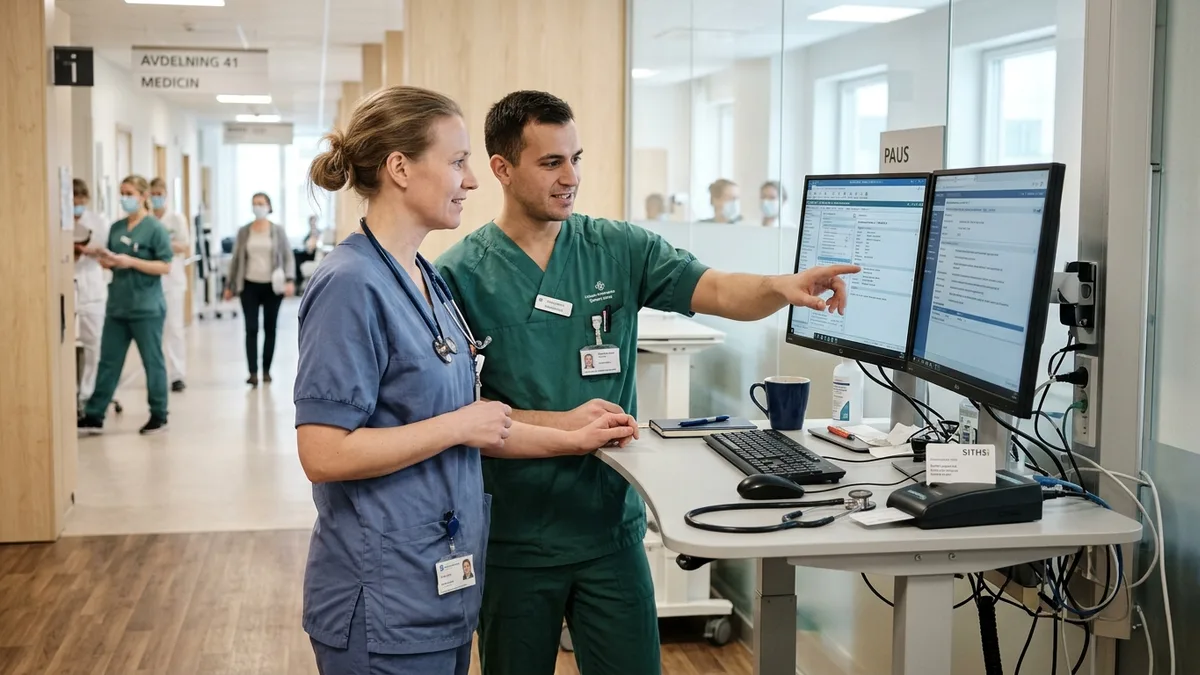
Photo: Lieselotte van der Meijs / imagebank.sweden.se