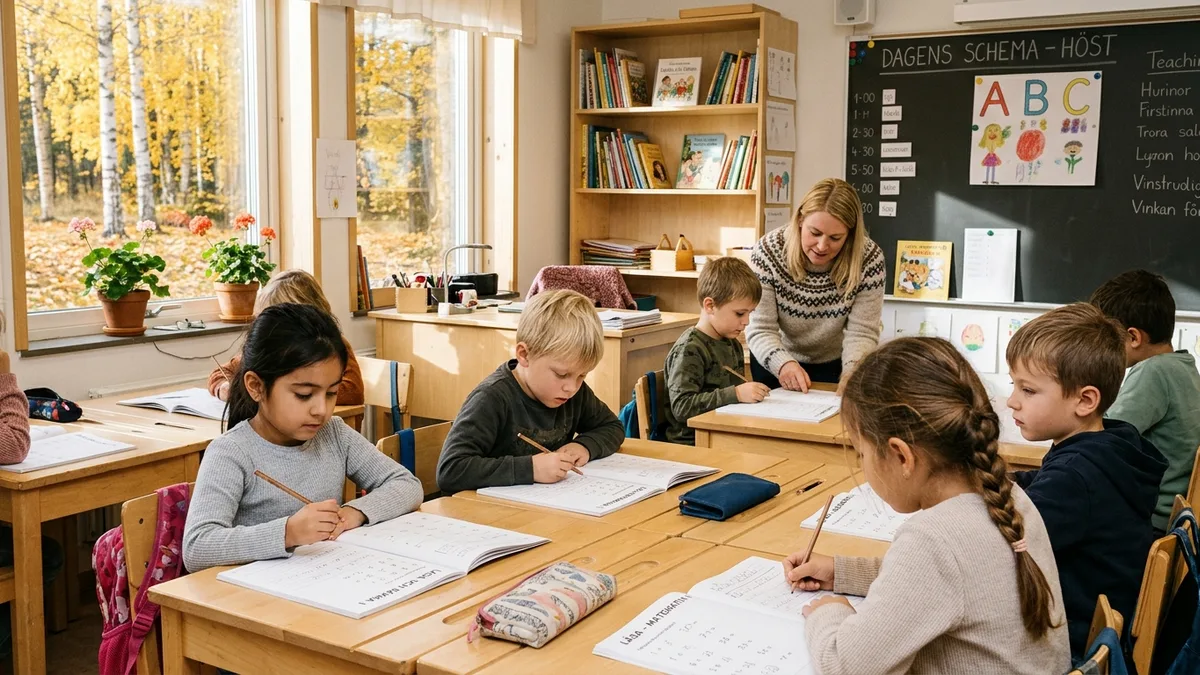
 Sunil Rao
Sweden is undertaking the largest structural overhaul of its compulsory school system in more than three decades. On Monday, 9 November 2026, the Swedish National Agency for Education (Skolverket) released its draft overhaul of the national school curricula (läroplaner) and approximately 80 subject syllabi (kursplaner) for public consultation (remiss) ahead of Sweden's transition to a 10-year compulsory school (tioårig grundskola) in autumn 2028.
Open for public feedback from 9 November 2026 through 20 January 2027 - before final delivery to the Government on 14 May 2027 - the new curriculum framework (widely referred to as Lgr28) replaces the separate one-year preschool class (förskoleklass) with a new Grade 1 (årskurs 1) that children enter in the autumn of the calendar year they turn six. At the same time, the reform marks a decisive break from decades of student-led digital experimentation, restoring structured teacher-led instruction, physical textbooks, handwriting, and early reading and mathematics fluency.
The release also coincided with new weekend statistics from the Swedish Work Environment Authority (Arbetsmiljöverket) showing 963 official incident reports of violence and threats in Swedish schools so far in 2026, underscoring why both Skolverket and the teachers' union (Sveriges Lärare) are prioritizing classroom order and earlier special-needs intervention. For expat parents raising young children in Sweden, here is everything you need to know about the 9 November 2026 curriculum reform, the age-six transition, and family childcare budgets.
1. From 9 Years to 10 Years: How the New Swedish School Structure Works
To understand why Skolverket rewrote ~80 syllabi at once, it helps to look at how Sweden's school stages (stadier) are being reorganized when the 10-year compulsory school (tioårig grundskola) takes effect in the autumn term of 2028:
| Child's Age (Calendar Year) | Current Structure (Lgr22 - Through Spring 2028) | New 10-Year Structure (Lgr28 - From Autumn 2028) | Key Pedagogical & Practical Shift |
|---|---|---|---|
| Ages 1 to 5 | Preschool (Förskola) | Preschool (Förskola) | Voluntary; maxtaxa fee cap (max 1,547 SEK/mo for Child 1 in 2026) |
| Year Turning 6 | Preschool Class (Förskoleklass / Grade F) | Grade 1 (Årskurs 1 - Lower Primary / Lågstadiet) | Förskoleklass abolished; structured early reading & math starts in Grade 1 |
| Years Turning 7 to 9 | Grades 1 to 3 (Lågstadiet - 3 years) | Grades 2 to 4 (Lågstadiet spans Grades 1-4 - 4 years) | Four full years in lower primary gives an extra year to master core literacy & numeracy |
| Years Turning 10 to 12 | Grades 4 to 6 (Mellanstadiet - 3 years) | Grades 5 to 7 (Mellanstadiet - 3 years) | Subject depth increases after foundational skills are secured |
| Years Turning 13 to 15 | Grades 7 to 9 (Högstadiet - 3 years) | Grades 8 to 10 (Högstadiet - 3 years; graduation after Grade 10) | Students graduate compulsory school after Grade 10 into upper secondary (gymnasiet) |
2. Five Major Classroom Changes Inside Skolverket's 9 November 2026 Proposal
In its 9 November 2026 consultation package, Skolverket detailed five concrete changes designed to reverse falling PISA reading and math scores among pupils with weaker socioeconomic or second-language backgrounds:
- Back-to-Basics Literacy & Numeracy in Grades 1-4: In the early years of compulsory school (the new four-year lågstadiet covering Grades 1 to 4 for ages 6 to 9), the syllabi for Swedish (svenska), Swedish as a Second Language (svenska som andraspråk, SVA), and Mathematics strip away abstract analytical requirements in favor of intensive practice in phonics, reading decoding, handwriting, spelling, and mental/written arithmetic.Play-based learning remains an important element for six-year-olds in the new Grade 1, but under the same unified compulsory-school curriculum rather than a separate school form.
- Brand-New "Teaching Strategies" (Undervisningsstrategier) for Teachers: For the first time in modern Swedish curriculum history, Skolverket has added explicit undervisningsstrategier to the syllabi. Previously, Swedish curricula told teachers what learning outcomes students should achieve, but left teaching methods entirely open - often leading to excessive independent project work by young pupils who lacked foundational knowledge. The new strategies strengthen the teacher's authority to lead structured whole-class instruction.
- Cutting Curriculum Crowding (Minskad stoffträngsel): Teachers across Sweden have long complained that existing syllabi cram too many topics into each stage, forcing classes to rush past fundamentals. Skolverket has trimmed and redistributed content across stages so subjects align with children's cognitive maturity.
- Overhauled Grading Criteria & Clearer Knowledge Assessments: Alongside the new 10-year structure, the curriculum consultation aligns subject syllabi with Sweden's broader grading reform, replacing vague qualitative value words that previously penalized students across entire courses for isolated sub-criteria.
- Addressing Classroom Safety & Early Support (963 Violence Reports in 2026): On 8-9 November 2026, data from the Swedish Work Environment Authority (Arbetsmiljöverket) revealed that Swedish schools recorded 963 formal serious incident reports of violence and threats up to early November 2026, with the teachers' union (Sveriges Lärare) warning that many of the most severe incidents occur in the lower grades when pupils with reading or neurodevelopmental difficulties fail to receive early small-group support. The new 10-year curriculum is designed to pair structured early instruction with earlier screening in Grade 1 so struggling six-year-olds get immediate remedial reading and language help.
3. How School Choice, International Schools & Bilingual Support Work for Expat Families
Whether your child attends a municipal Swedish school (kommunal grundskola) or an independent voucher school (friskola, such as Internationella Engelska Skolan), the national curriculum set by Skolverket applies across the board (except for fully accredited IB international schools serving temporary diplomats and corporate assignees):
- Swedish as a Second Language (Svenska som andraspråk, SVA): Under the Education Act (Skollagen) and Skolverket's new syllabi, expat children whose native language is not Swedish have a statutory right to be taught under the SVA syllabus if the principal assesses that they need targeted second-language instruction to reach full academic proficiency in Swedish.
- Mother-Tongue Instruction (Modersmålsundervisning): If at least one parent/guardian speaks a language other than Swedish daily with the child at home and the child has basic knowledge of that language, municipalities are required to offer mother-tongue classes (provided at least five pupils in the municipality request the language and a qualified teacher is available).
- Don't Forfeit Your Parental Leave Days When Your Child Turns 4 or Starts School: Remember that while compulsory school is shifting to a 10-year structure, Försäkringskassan's strict "4-year cutoff rule" on parental benefit days (föräldrapenning) still applies: after your child's fourth birthday, you and your partner can only save a combined maximum of 96 parental leave days (to be used before the child turns 12 or finishes the old Grade 5 / new Grade 6). Any unused days above 96 are permanently forfeited on the day your child turns 4.
4. Family Budget Impact: Preschool (Förskola) vs. After-School Care (Fritidshem) Costs in 2026-2027
When your child transitions from preschool (förskola) into compulsory school in the autumn of the year they turn six, your household childcare bill drops automatically. While compulsory school hours (roughly 08:15 to 13:30/14:00 in the lower grades, including hot lunch) are 100 percent free, working parents enroll their six-to-twelve-year-olds in the school's integrated morning and afternoon care club (fritidshem or "fritids").
Under Sweden's national maximum fee regulation (maxtaxa), the municipal fee cap drops by one-third as soon as your child moves from preschool into school-age fritidshem in August of the year they turn six:
| Childcare Stage & Child Order (Youngest = Child 1) | Statutory % of Household Gross Income | Maximum Monthly Fee Cap in 2026 (at 51,567 SEK/mo Ceiling) | Hours & Free Entitlement Rules |
|---|---|---|---|
| Preschool (Förskola, Ages 1-5) - Child 1 (Youngest) | 3% of gross household income | 1,547 SEK/month (reduced by ~25-30% from Sept of age 3 due to 525 free hours/yr) | Full-time while parents work, study, or job-seek (15 hrs/wk during parental leave) |
| Preschool (Förskola, Ages 1-5) - Child 2 | 2% of gross household income | 1,031 SEK/month | Sibling discount applied automatically across preschool and fritidshem |
| Preschool (Förskola, Ages 1-5) - Child 3 | 1% of gross household income | 516 SEK/month (Child 4+ is 0 SEK) | Fourth and subsequent children are 100% free |
| School-Age Club (Fritidshem, Ages 6-12) - Child 1 | 2% of gross household income | 1,031 SEK/month | Covers morning care before school, afternoon care until ~17:00-18:00, and school holidays (lov) |
| School-Age Club (Fritidshem, Ages 6-12) - Child 2 | 1% of gross household income | 516 SEK/month | Applies when an older child is in fritidshem and a younger sibling is in preschool |
| Compulsory School Tuition, Lunch & Books (Grades 1-10) | 0% (100% Tax-Funded) | 0 SEK/month | Includes nutritious hot lunch every school day, books, and school nurse |
2026-2027 Family Budget Case Study: Two-Child Expat Family in Uppsala Transitioning Into School & Fritidshem
Consider Elena and Carlos, a dual-income expat family in Uppsala with a combined gross monthly income of 88,000 SEK (exceeding the 51,567 SEK/month municipal maxtaxa income ceiling) and two children: Lucas (turning 6) and Maya (aged 2):
- Step 1 - How Sweden's "Youngest Child = Child 1" Rule Works: Under national maxtaxa rules, the youngest child in municipal care is always counted as Child 1, and the next-youngest as Child 2. Because 2-year-old Maya is the youngest, she is Child 1 in preschool (3 percent of the 51,567 SEK ceiling = 1,547 SEK/month).
- Step 2 - Automatic Fee Drop When 6-Year-Old Lucas Enters School & Fritidshem: While Lucas was 5 years old in preschool, he was counted as Child 2 at the preschool rate (2 percent of ceiling = 1,031 SEK/month, minus the universal 15-hour/week allmän förskola discount during school terms). Once Lucas starts compulsory school in August of the year he turns 6, his daytime school hours (08:15-13:30) and daily hot lunches become 100 percent free, and his afternoon enrollment in fritidshem is billed at the Child 2 fritidshem rate of just 1 percent of the ceiling: 516 SEK per month!
- Step 3 - Total Monthly Childcare Cost + Child Allowance (Barnbidrag) Offset: Elena and Carlos pay 1,547 SEK/month for Maya's full-time preschool plus 516 SEK/month for Lucas's full-time after-school and holiday club - a total family childcare bill of 2,063 SEK/month. At the same time, Försäkringskassan pays them 2,650 SEK/month in tax-free universal child allowance (1,250 SEK/month per child plus the 150 SEK/month two-child supplement, flerbarnstillägg), meaning their monthly state child allowance completely covers 100 percent of their preschool and fritidshem fees with 587 SEK/month left over.
Sources
- Swedish National Agency for Education (Skolverket) - Press Release: Proposals for New Curricula and Syllabi Sent Out for Consultation (Förslag på nya läro- och kursplaner ute på remiss, 9 November 2026 - 20 January 2027)
- Swedish National Agency for Education (Skolverket) - Official Guide to the 10-Year Compulsory School Reform (En tioårig grundskola från hösten 2028 - Lgr28)
- Swedish Work Environment Authority (Arbetsmiljöverket) - 2026 School Work Environment & Incident Statistics
- Swedish National Agency for Education (Skolverket) - Statutory Maximum Fees in Preschool and After-School Care (Maxtaxa i förskola och fritidshem)
Related articles
Frequently asked questions
What did Skolverket announce on 9 November 2026 regarding Sweden's school curricula?
On Monday, 9 November 2026, the Swedish National Agency for Education (Skolverket) published its draft proposals for completely revised national curricula (läroplaner) and approximately 80 subject syllabi (kursplaner) for Sweden's compulsory school (grundskola), adapted compulsory school (anpassad grundskola), special school (specialskola), Sami school (sameskola), and after-school care (fritidshem). The consultation period (remiss) runs from 9 November 2026 to 20 January 2027, after which Skolverket will deliver its final proposals to the Government on 14 May 2027 ahead of implementation in autumn 2028 (Lgr28).
How does the new 10-year compulsory school (tioårig grundskola) change when children start Grade 1 in Sweden?
Currently, children in Sweden attend a separate one-year compulsory preschool class (förskoleklass, Grade F) the calendar year they turn 6, followed by Grades 1 to 9 (a 1+9 structure). Starting in the autumn term of 2028, förskoleklass is abolished as a separate school form and replaced by a new Grade 1 in a unified 10-year compulsory school (Grades 1 to 10). Children will begin Grade 1 in August of the calendar year they turn 6, and graduate from compulsory school after Grade 10 the year they turn 16.
Which birth cohorts of children in Sweden are the first to enter the new 10-year Grade 1?
Children born in 2022 (who turn 6 during calendar year 2028) will be the first cohort to start directly in the new Grade 1 of the 10-year grundskola in August 2028 under the new Lgr28 curriculum. Children born in 2020 and 2021 (starting school in August 2026 and August 2027) enter under the transitional rules leading into the 2028 rollout.
What are the biggest teaching and classroom changes in Skolverket's 9 November 2026 curriculum proposal?
Skolverket's draft Lgr28 curricula introduce four major pedagogical shifts: (1) Back-to-basics early foundations: much stronger focus in Grades 1-3 on foundational reading decoding, handwriting, spelling, and basic arithmetic before abstract problem-solving; (2) Reduced curriculum crowding (minskad stoffträngsel): stripping out overly theoretical criteria in lower grades to match children's cognitive development; (3) Explicit Teaching Strategies (undervisningsstrategier): adding a brand-new section to syllabi that gives teachers concrete guidance on structured, teacher-led classroom instruction; and (4) Physical textbooks and screen limits in early years.
Can parents and teachers submit feedback to Skolverket's curriculum consultation before 20 January 2027?
Yes. While Skolverket formally sends the consultation package to municipalities, universities, unions, and government agencies, the consultation on skolverket.se is open to the general public between 9 November 2026 and 20 January 2027, allowing any parent, teacher, or school principal in Sweden to submit written observations.
How does the 10-year school reform affect preschool (förskola) and after-school club (fritidshem) maxtaxa fees?
Compulsory school (grundskola) itself is 100 percent free of charge in Sweden (including free hot school lunches, textbooks, and school health services). However, parents working or studying whose children aged 6 to 12 attend the before- and after-school program (fritidshem) pay a subsidized municipal fee under Sweden's national maxtaxa cap: for Child 1 in fritidshem, the fee is capped at 2 percent of household gross monthly income up to the statutory ceiling (1,031 SEK/month in 2026, compared with 3 percent or 1,547 SEK/month in preschool).
Estimate only. Talk to a qualified adviser before acting on anything here.
Photo: Lieselotte van der Meijs / imagebank.sweden.se