 Sunil Rao
For anyone planning to buy or sell a home in Sweden this winter, Tuesday morning, 10 November 2026, delivered two pivotal reality checks within the same hour. First, state-owned mortgage lender SBAB and housing data platform Booli published their October 2026 housing market reports (including the monthly Bomarknadstempen liquidity index), revealing that while overall Swedish home prices dipped 1.5 percent in October, detached house (villa) prices dropped by 2.4 percent even as tenant-owner apartments (bostadsrätter) edged up by 0.3 percent.
Second, at 09:30 CET on 10 November 2026 - just 24 hours before Sweden's new 2.00 percent benchmark policy rate (styrränta) formally takes effect on Wednesday, 11 November - Sveriges Riksbank released the complete Monetary Policy Minutes (Penningpolitiskt protokoll) from its 3 November Executive Board meeting. In the minutes, Governor Erik Thedéen and the Board members confirmed that the November rate hike is not intended as a one-off adjustment: if economic activity and inflation follow the central bank's baseline, the Riksbank plans to continue raising the policy rate gradually over the next six to twelve months.
Below is our full analysis of the 10 November 2026 SBAB/Booli housing data, the key takeaways from the Riksbank's November minutes, and a step-by-step financial comparison for expats and Swedish families weighing whether to buy a villa or apartment this winter.
1. Inside SBAB & Booli's 10 November 2026 Housing Report: A Split Market Between Villas and Apartments
Every month, SBAB and Booli track both actual signed transaction prices across Sweden and Bomarknadstempen - a composite temperature gauge measuring how easy or difficult it is for sellers to offload a property based on unsold supply, average days on Booli, bidding premiums, the number of active bidders per listing, and the share of properties forced to cut their asking price.
The October 2026 figures released on 10 November 2026 show a clear split between Sweden's detached house market and its urban condominium market:
- Headline Price Drop (-1.5% Unadjusted, Flat Seasonally Adjusted): Across Sweden as a whole, composite housing prices fell by 1.5 percent in October 2026. Because Swedish home prices normally dip in mid-autumn as the post-summer listing wave peaks, seasonally adjusted national prices stood virtually still.
- Villas Drop 2.4% (Weaker Than Seasonal Norm): Detached single-family houses (villor) fell by 2.4 percent in October 2026 - a sharper drop than normal seasonal patterns explain. While the total number of houses sold nationwide remains clearly above historical trend levels, SBAB and Booli noted that villa sellers are experiencing longer selling times and a higher-than-normal share of price-cut listings (prissänkta objekt), even though overall villa market temperature is rated as normal in Stockholm County and near-normal in Västra Götaland and Skåne.
- Apartments Rise 0.3% (Stronger Than Seasonal Norm, Led by Larger Units): In contrast to villas, apartment (bostadsrätt) prices rose by 0.3 percent in October 2026, outperforming the typical October seasonal trend. However, Bomarknadstempen highlights a sharp divide by apartment size and location: family-sized three-room and four-room apartments in central Stockholm (Stockholms innerstad/kommun) and central Gothenburg are selling briskly with healthy bidding premiums, whereas small studio and one-bedroom apartments (ettor och tvåor) across regional towns remain weighed down by record supply and long advertising times.
| Housing Market Segment / Metric (Oct 2026 Data) | October 2026 Outcome | Seasonal / Historical Comparison | Buyer & Seller Takeaway (Nov 2026) |
|---|---|---|---|
| Sweden Composite Home Prices (All Homes) | -1.5% in October | ~0.0% seasonally adjusted | Overall market moving sideways entering winter |
| Detached Houses (Villor) - Price Change | -2.4% in October | Weaker than normal October trend | Higher share of price cuts & longer selling times favor buyers |
| Apartments (Bostadsrätter) - Price Change | +0.3% in October | Stronger than normal October trend | Central Stockholm/Gothenburg & larger apartments lead demand |
| SBAB / Booli Bomarknadstempen (Liquidity Index) | Unchanged vs. September | Bidding premiums near normal; supply still high | Two-tier market: family apartments hot, small studios slow |
| Villa Transaction Volume (Nationwide) | Above historical trend | Normal temperature in Stockholm; near-normal in VG/Skåne | High turnover continues, but buyers refuse to overpay |
2. Inside the 10 November 2026 Riksbank Minutes: Why the Board Signaled More Rate Hikes Ahead
Why did Swedish villa buyers turn cautious in October and early November 2026? The answer lies in the monetary policy shift detailed in the Monetary Policy Minutes (Penningpolitiskt protokoll) published by Sveriges Riksbank on Tuesday morning, 10 November 2026, covering the Executive Board's meeting on 3 November 2026.
In those minutes, Governor Erik Thedéen and the Executive Board members explained the internal deliberations behind raising the policy rate by 0.25 percentage points from 1.75 percent to 2.00 percent (effective Wednesday, 11 November 2026):
- Gradual Rate Hikes Over the Coming Half-Year: Governor Erik Thedéen and the Board emphasized in the minutes that if the economic recovery and inflation outlook develop as projected - and barring major unexpected shocks - it lies in the Riksbank's plans to continue raising the policy rate gradually over the coming six-to-twelve months in line with the September rate path (which projects the policy rate averaging 2.07% in Q1 2027, 2.24% in Q2 2027, and 2.38% in Q3 2027).
- Preventing International Cost Shocks From Biting into Domestic Demand: The Board members highlighted a specific macroeconomic risk: because Sweden's domestic GDP and labor market are strengthening toward normal capacity utilization at the exact same time that the war in the Middle East is driving up global energy and freight costs and the krona remains weak, companies could find it easier to pass higher costs onto Swedish consumers in 2027.
- Looking Through Temporary 2026 Tax Cuts: The minutes confirmed that the Board is completely looking through the artificially low headline CPIF readings of autumn 2026 (1.5% in September and 1.1% in the October flash estimate) because CPIF excluding temporary fiscal tax cuts stood at 3.0 percent in September, while SCB's Q3 2026 Service Price Index surged 3.9 percent year-on-year.
3. Full 2026-2027 Cost Breakdown: Buying a 6,500,000 SEK Swedish Villa vs. a 4,500,000 SEK Apartment
If you are an expat family deciding whether to take advantage of the 2.4 percent October dip in Swedish villa prices or buy a larger family apartment, you must factor in Sweden's statutory closing costs, the 90 percent LTV mortgage cap (effective since 1 April 2026), and the new 2.00 percent Riksbank policy rate environment:
| Cost / Rule Parameter (Nov 2026 - 2027) | Detached Villa (Småhus / Villa - 6,500,000 SEK) | Co-op Apartment (Bostadsrätt - 4,500,000 SEK) | Statutory Rule / Agency Reference |
|---|---|---|---|
| Minimum 10% Cash Down Payment (Kontantinsats) | 650,000 SEK (at 90% max LTV) | 450,000 SEK (at 90% max LTV) | Finansinspektionen 90% LTV rule (from 1 Apr 2026) |
| Title Deed Stamp Duty (Lagfart - 1.5% + 825 SEK) | 98,325 SEK (upfront cash cost) | 0 SEK (no lagfart on bostadsrätt) | Lantmäteriet statutory property registration |
| New Mortgage Deed Fee (Pantbrev - 2.0% + 375 SEK) | 40,375 SEK (assuming 2M SEK new pantbrev) | 0 SEK (no pantbrev on bostadsrätt) | Lantmäteriet (2.0% on new deeds above existing pantbrev) |
| Municipal Property Fee (Kommunal fastighetsavgift) | 10,425 SEK/year (869 SEK/mo) | Included in monthly BRF fee | Skatteverket 2026 cap (0.75% up to 10,425 SEK) |
| Net Monthly Mortgage Interest (at 3.30% after Nov Hike) | 11,769 SEK/mo (on 5.85M loan after ränteavdrag) | 8,663 SEK/mo (on 4.05M loan after ränteavdrag) | 30% ränteavdrag up to 100k SEK/person, 21% above |
| Mandatory Amortization (2% LTV > 70%) | 9,750 SEK/mo (or 14,625 SEK/mo if > 4.5x income) | 6,750 SEK/mo (or 10,125 SEK/mo if > 4.5x income) | Statutory amortization requirement (amorteringskrav) |
2026-2027 Financial Case Study: Negotiating a Price Cut on a Suburban Stockholm Villa in November 2026
Consider Sofia and Liam, an international couple in Stockholm with a combined gross household income of 115,000 SEK per month (1,380,000 SEK per year) and 1,150,000 SEK in savings. They are looking at a detached villa in Täby originally listed at 6,650,000 SEK in September 2026 that has sat unsold for 42 days on Booli:
- Step 1 - Using the 10 November SBAB/Booli Data in Price Negotiations: Citing the 2.4 percent October drop in national villa prices and the Riksbank's 2.00 percent policy rate hike effective 11 November 2026, Sofia and Liam submit a firm, financing-ready bid of 6,400,000 SEK (a 250,000 SEK or 3.76 percent discount off the original asking price), which the seller accepts to avoid carrying the empty house through winter.
- Step 2 - Optimizing LTV at 85% Instead of 90% to Preserve Cash for Closing Costs: Although Sweden's 90 percent LTV cap allows them to put down just 640,000 SEK (10%), a villa purchase requires upfront cash for the 1.5 percent lagfart stamp duty (96,825 SEK on 6,400,000 SEK) plus 2.0 percent for any new pantbrev mortgage deeds (the house already has 4,800,000 SEK in existing pantbrev, so issuing 640,000 SEK in new deeds to reach an 85% loan of 5,440,000 SEK costs 13,175 SEK). They put down 15 percent (960,000 SEK), pay 110,000 SEK in total lagfart and pantbrev fees, and keep 80,000 SEK as their emergency maintenance buffer.
- Step 3 - Stress-Testing Monthly Cash Flow Under the Riksbank's 2027 Rate Path: Their mortgage is 5,440,000 SEK (85% LTV), which is 3.94 times their 1,380,000 SEK gross annual income (staying safely below the 4.5x debt-to-income threshold, so their mandatory amortization is 2.0 percent per year, or 9,067 SEK/month). If their variable mortgage rate rises from 3.10 percent in November 2026 to 3.45 percent in mid-2027 in line with the Riksbank's 10 November minutes, their gross annual interest will be 187,680 SEK (93,840 SEK per spouse, keeping 100 percent of their interest inside the full 30 percent ränteavdrag cap of 100,000 SEK per person!). Their net after-tax interest cost in 2027 is 131,376 SEK/year (10,948 SEK/month). Even with the higher 2027 interest rate, the 250,000 SEK purchase price discount they negotiated in November 2026 saves them more than 14 years of that extra 0.35 percentage point interest hike.
4. Four Tactical Rules for Buying or Selling Property in Sweden This Winter
Whether you are house-hunting or preparing to list an apartment between November 2026 and Q1 2027, apply these four data-backed rules from today's SBAB/Booli and Riksbank releases:
- Target Price-Cut Villas in November and December 2026: Because SBAB and Booli confirm that the share of price-reduced villas on Booli is above normal while buyer traffic thins out before Christmas, buyers with an approved mortgage promise (lånelöfte) have maximum negotiating leverage on detached houses between mid-November and late December.
- Verify Existing Mortgage Deeds (Befintliga Pantbrev) Before Bidding on Any Villa: Unlike apartments, every kroner you borrow on a detached house above the property's existing registered pantbrev triggers a non-refundable 2.0 percent state tax to Lantmäteriet. Always check the broker's object description (objektsbeskrivning) for existing pantbrev before calculating your maximum bid.
- Audit the BRF's Debt Per Square Meter Before Buying a Large Apartment: While larger family apartments rose 0.3 percent in October 2026, the Riksbank's 10 November minutes confirm that interest rates are heading higher into 2027. Avoid housing associations with more than 10,000 SEK in BRF debt per square meter (skuldsättning per kvadratmeter), as those associations face upward pressure on monthly fees (månadsavgifter) when their fixed commercial bank loans roll over in 2027.
- Split Mortgage Liability 50/50 With Your Spouse or Sambo: As variable mortgage rates move above 3.25-3.50 percent in 2027, any loan above roughly 3,000,000 SEK generates more than 100,000 SEK in annual interest. Make sure both co-borrowers are registered as 50/50 payment-liable on the bank promissory note so your household can claim the full 30 percent tax deduction (ränteavdrag) on up to 200,000 SEK of combined annual mortgage interest.
Sources
- SBAB & Booli - Press Release: Bomarknadstempen and Swedish Housing Price Development for October 2026 (Published 10 November 2026)
- Sveriges Riksbank - Monetary Policy Minutes from the Executive Board Meeting on 3 November 2026 (Penningpolitiskt protokoll november 2026, Published 10 November 2026)
- Swedish Financial Supervisory Authority (Finansinspektionen) - Swedish Mortgage Cap (90% LTV / 10% Minimum Down Payment) & Amortization Rules
- Lantmäteriet - Official Stamp Duty and Registration Fees for Title Deeds (Lagfart 1.5%) and Mortgage Deeds (Pantbrev 2.0%)
Related articles
Frequently asked questions
How much did Swedish house and apartment prices change in October 2026?
According to the October 2026 housing price data and Bomarknadstempen indicator published by state mortgage lender SBAB and Booli on 10 November 2026, overall Swedish housing prices fell by 1.5 percent in October 2026 (roughly flat after adjusting for normal autumn seasonal effects). However, the national total masks a sharp divergence between property types: detached houses (villor) dropped by 2.4 percent in October (a larger decline than normal for October), whereas tenant-owner apartments (bostadsrätter) rose by 0.3 percent.
What did SBAB and Booli's Bomarknadstempen reveal on 10 November 2026 about how easy it is to sell a home?
In its 10 November 2026 release, SBAB and Booli's Bomarknadstempen (which measures housing market liquidity based on supply, days on market, bidding premiums, and price cuts) moved sideways in October 2026, remaining unchanged compared with September. Larger apartments and central Stockholm and Gothenburg locations remain significantly hotter than smaller one-room and two-room apartments, which face high unsold supply and longer advertising times. On the villa market, transaction volumes exceed historical trend levels, but sellers face longer listing times and a higher-than-normal share of price reductions.
What did the Riksbank's 10 November 2026 Monetary Policy Minutes reveal about future mortgage rates?
Published at 09:30 CET on Tuesday, 10 November 2026, the Monetary Policy Minutes (Penningpolitiskt protokoll) from the 3 November 2026 Executive Board meeting confirmed why the Board raised the policy rate from 1.75 percent to 2.00 percent (effective 11 November 2026). Governor Erik Thedéen and the Board members emphasized that if economic recovery and inflation developments hold without major surprises, the Riksbank plans to continue raising the policy rate gradually over the coming six-to-twelve months so that international supply shocks and a weak krona do not become entrenched in domestic pricing.
Why did villa prices fall 2.4% in October while apartments rose 0.3%?
Three structural factors explain why detached houses (villor) underperformed apartments in October 2026: (1) Autumn/winter seasonal cooling hits houses harder as buyers factor in rising winter heating, electricity, and maintenance costs; (2) Villa buyers in metropolitan regions borrow larger absolute krona amounts and are more sensitive to the Riksbank's shift back to interest rate hikes; and (3) Sweden's higher 90 percent LTV mortgage cap (10 percent minimum down payment, introduced 1 April 2026) gave first-time and upgrading apartment buyers in central Stockholm and Gothenburg an extra boost in purchasing power.
What is the minimum down payment (kontantinsats) to buy a home in Sweden in November 2026?
Since 1 April 2026, Sweden's statutory mortgage cap (bolånetak) allows homebuyers to borrow up to 90 percent of the property's market value (up from the previous 85 percent cap), reducing the mandatory minimum cash down payment (kontantinsats) to 10 percent. However, borrowing above 85 percent LTV still triggers mandatory amortization requirements (2 percent per year above 70% LTV, plus an additional 1 percent per year if total household mortgage debt exceeds 4.5 times gross annual income).
Should buyers bid on a Swedish villa in November-December 2026 or wait until spring 2027?
For buyers who have already secured a mortgage promise (lånelöfte) and have stable income headroom, late November and December 2026 offer a strong buyer's market for detached houses. Because SBAB/Booli data shows an elevated share of price-cut villas and longer selling times in October-November, buyers face fewer competing bidders now than they will during the traditional spring listing surge, even if variable mortgage rates edge slightly higher in early 2027.
Estimate only. Talk to a qualified adviser before acting on anything here.
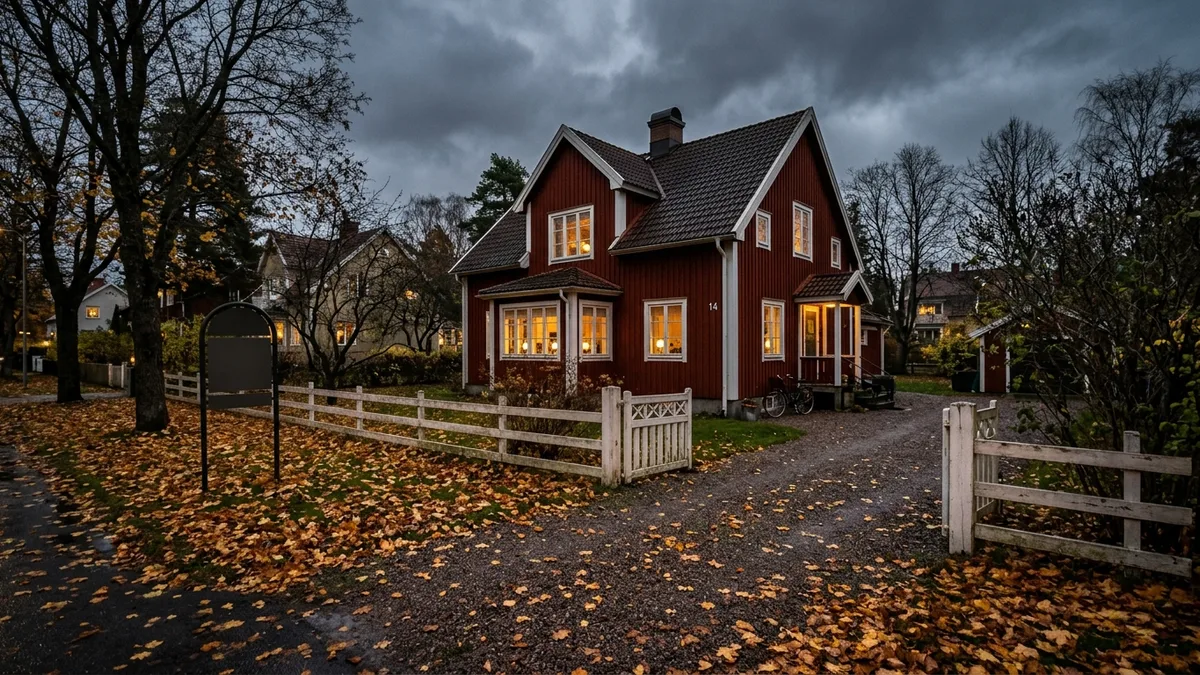
Photo: Simon Paulin / imagebank.sweden.se